.png)
.png)

BLOG

香港德國文化協會
The German Cultural Association
German Prepositions: Which Case Does Each One Take? Complete Tables
You're writing an email to a German university, preparing for an IGCSE or IB assessment, or revising for Goethe-Zertifikat A2/B1. Then you meet a sentence such as Ich gehe in die Schule, followed by Ich bin in der Schule, and the familiar English meaning of “in” suddenly stops helping. The preposition is the same, but the case changes.
This guide to German Prepositions: Which Case Does Each One Take? Complete Tables gives you a practical system for Hong Kong study, work and travel. You'll learn four memorisable tables, a reliable movement-versus-location decision step, and the contracted forms that can either strengthen or weaken a written answer.
Table of Contents
- 1. The article disappears or changes incorrectly
- 2. Dative becomes the default
- 3. Spoken contractions enter formal writing unchecked
- Do the case rules apply to speaking as well as writing?
- Which categories deserve the most attention for DSE, IGCSE, IB and TestDaF?
- Can a two-way preposition take either case in the same sentence?
- Can spoken German use von plus dative instead of a genitive preposition?
The Hong Kong Learner's Preposition Problem
At a Kowloon tutorial centre, a Form 6 DSE candidate or IB Year 1 student may understand every word in Ich gehe in die Schule, yet hesitate over in der Schule. English encourages a direct translation, “in means inside”, but German asks a second question: is someone moving towards a place, or already located there?
That distinction matters in Goethe-Zertifikat A2 and B1 school modules, IGCSE German, IB Ab Initio and SL, and the reading sections of TestDaF. It also matters outside examinations, especially when you're writing to a German university, preparing documents for a visa, or communicating with a German-speaking employer.
Hong Kong learners often have less everyday classroom exposure to German than to English or Chinese. A University of Hong Kong-linked dataset recorded German in 4 secondary schools with 166 students in the 2016/2017 school year, while another table listed 90 German students across four schools, compared with 603 for Spanish and 435 for French. The same source reported that only 22 to 25 new students typically enrolled each year to learn German as a second foreign language. The HK-focused enrolment discussion helps explain why structured grammar support is valuable.
Adult demand has nevertheless remained measurable. A DAAD Hong Kong country report and related local timeline states that adult German learners rose from about 4,000 in 2012 to over 5,000 in the previous year, while Goethe-Institut Hongkong's brochure says it serves about 3,000 learners annually and has reached more than 50,000 learners since opening in 1963. Precise case control is therefore useful for adults, parents, professionals and students planning to study abroad in Germany or Spain.
What German Prepositions Are and Why They Demand a Case
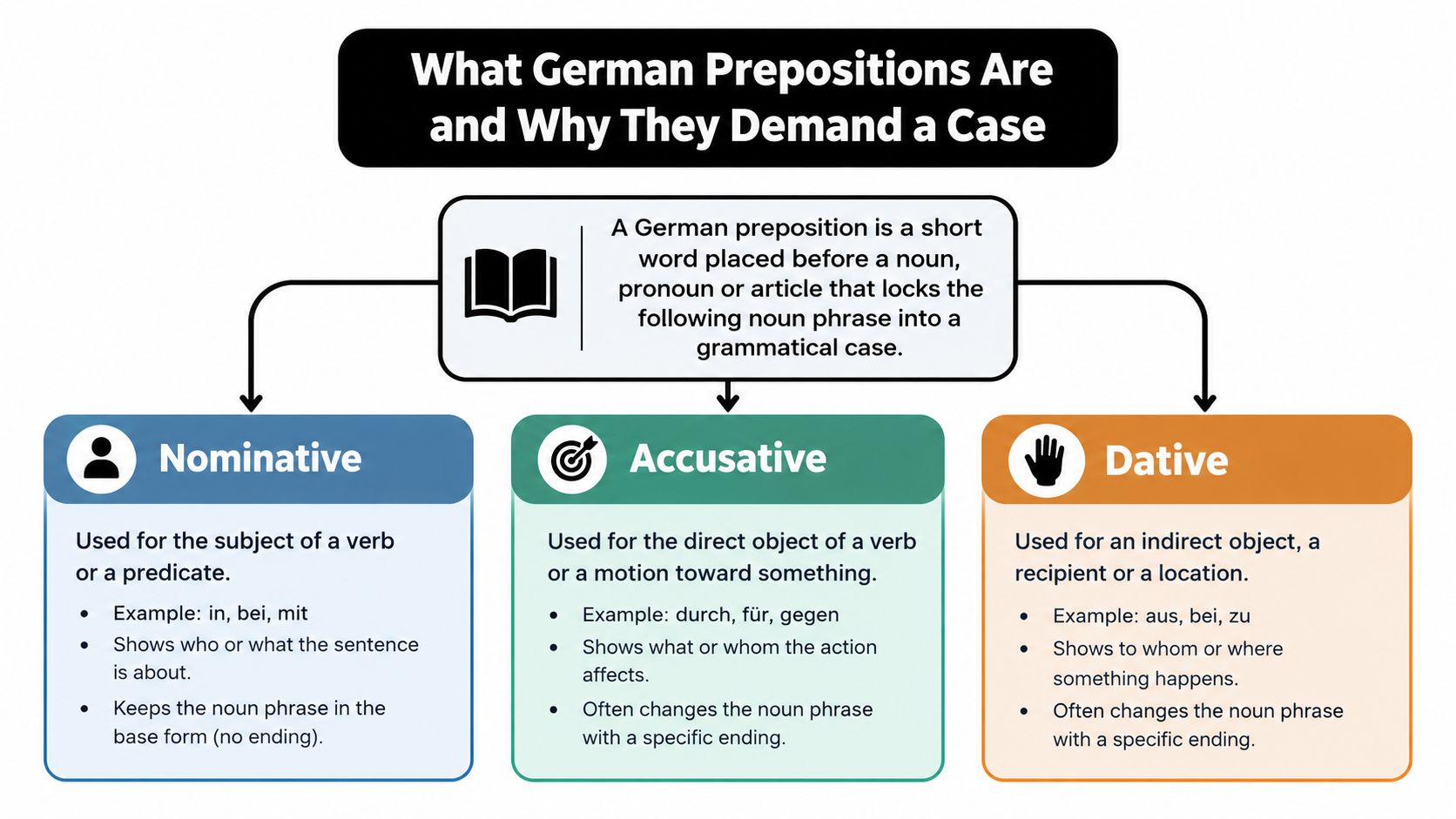
A German preposition is a short word placed before a noun, pronoun or article that locks the following noun phrase into a grammatical case. The article and adjective endings then change to match that case, so the preposition affects the form of the whole phrase.
The four cases in practical terms
Nominative identifies the doer of the action. In Die Studentin lernt Deutsch, die Studentin performs the learning, so it remains in the nominative.
Accusative usually identifies the direct object, the person or thing directly affected by an action. It also follows a two-way preposition when the sentence expresses movement towards a destination. In Ich sehe den Lehrer, the masculine article changes from der to den.
Dative identifies a recipient or a stationary location. In Ich helfe meiner Lehrerin, meiner Lehrerin receives the help, and meiner isn't optional decoration. Dative also appears in Ich bin in der Schule, because the speaker is already located there.
Genitive expresses possession or a formal relationship. In das Buch des Studenten, des Studenten shows whose book it is. Genitive prepositions are particularly useful in formal writing and academic reading.
The main categories are:
- Accusative-only prepositions, which always require accusative.
- Dative-only prepositions, which always require dative.
- Two-way prepositions, which use accusative for direction and dative for position.
- Genitive prepositions, which commonly appear in formal or academic German.
The German preposition overview from deutsch.info follows this same case-based structure, which is more reliable than memorising each English translation separately.
Accusative Prepositions You Can Memorise in One Sitting
Accusative-only prepositions don't change case according to movement or location. Once you recognise one of these prepositions, choose the accusative and move on.
| Preposition | English | Contraction | Quick cue |
|---|---|---|---|
| durch | through | durchs | passing through |
| für | for | fürs | recipient or purpose |
| gegen | against | none | opposition |
| ohne | without | none | absence |
| um | around, at | ums | surrounding or time |
| bis | until, as far as | none | endpoint |
| entlang | along | none | route |
| wider | against | none | formal opposition |
The core group is easy to recall as durch, für, gegen, ohne, um. The German accusative explanation for Hong Kong learners gives further practice with the masculine article change from der to den.
Three worked examples
Ich gehe durch den Park in Kowloon Park.
durch always takes accusative. The masculine noun phrase is den Park, not dem Park.
Das Geschenk ist für meinen Bruder.
für takes accusative, so mein Bruder becomes meinen Bruder. The phrase names the recipient or intended beneficiary.
Wir kämpfen gegen den Lärm in Mong Kok.
gegen takes accusative even though there's no physical movement. den Lärm expresses abstract opposition.
Practical rule: With an accusative-only preposition, don't ask Wo? or Wohin?. Ask which accusative form the article, adjective or pronoun needs.
Watch the contracted forms in reading and listening. durchs equals durch das, fürs equals für das, and ums equals um das. The contraction doesn't remove the accusative case. It combines two words while preserving the same grammatical relationship.
Dative Prepositions and the Traps They Set for HK Learners
The canonical dative sequence is aus, bei, mit, nach, seit, von, zu. Many learners memorise it as Aus, Bei, Mit, Nach, Seit, Von, Zu, while a phrase such as mit dem Bus provides a useful classroom anchor.
| Preposition | Meaning | Contracted form | Example with dative |
|---|---|---|---|
| aus | from, out of | none | aus dem Haus |
| bei | at, with, near | beim | beim Arzt |
| gegenüber | opposite, across from | none | gegenüber dem Bahnhof |
| mit | with, by means of | none | mit dem MTR |
| nach | to, after | none | nach Deutschland |
| seit | since, for | none | seit dem Jahr 2020 |
| von | from, of | vom | vom Lehrer |
| zu | to, at | zum, zur | zur Universität |
Cantonese-speaking learners often meet three recurring traps. First, mit describes accompaniment or means, while bei describes being at or with a person or institution. Second, English “to” may translate as zu, nach, or a two-way preposition such as in, depending on the destination. Third, the dative masculine and neuter forms dem and -m can disappear in fast speech, but they still need to appear in careful writing.
Hong Kong examples
Ich treffe meine Freundin mit dem MTR.
The means of transport follows mit, so the phrase is mit dem MTR.
Ich fahre nach Deutschland.
For a country name without an article, use nach, not zu.
Ich lerne seit dem Jahr 2020 Deutsch.
seit requires dative, giving dem Jahr.
A useful contrast is:
- Wrong: Ich bin bei den Bahnhof.
- Right: Ich bin bei dem Bahnhof, or more naturally, beim Bahnhof.
The issue isn't the English meaning of “at”. bei selects dative, so the phrase must be dem Bahnhof. The dative and genitive guide for HK beginners offers additional examples of these article changes.
Two-Way Prepositions and the Movement vs Location Rule
The nine two-way prepositions, or Wechselpräpositionen, are an, auf, hinter, in, neben, über, unter, vor, zwischen. They take accusative when the sentence answers Wohin?, meaning “where to?”, and dative when it answers Wo?, meaning “where?”
| Preposition | Accusative, Wohin? | Dative, Wo? | Example pair |
|---|---|---|---|
| an | onto, towards | at, on | Ich hänge das Bild an die Wand. / Das Bild hängt an der Wand. |
| auf | onto | on | Ich lege das Buch auf den Tisch. / Das Buch liegt auf dem Tisch. |
| hinter | behind, to behind | behind | Ich stelle den Stuhl hinter die Tür. / Der Stuhl steht hinter der Tür. |
| in | into, to | in | Ich gehe in die Klasse. / Ich bin in der Klasse. |
| neben | next to, to beside | next to | Ich setze mich neben den Schüler. / Ich sitze neben dem Schüler. |
| über | over, to above | above, over | Ich hänge die Lampe über den Tisch. / Die Lampe hängt über dem Tisch. |
| unter | under, to beneath | under | Ich stelle die Tasche unter den Stuhl. / Die Tasche steht unter dem Stuhl. |
| vor | in front of, to the front of | in front of | Ich stelle das Fahrrad vor das Haus. / Das Fahrrad steht vor dem Haus. |
| zwischen | between, to between | between | Ich lege das Heft zwischen die Bücher. / Das Heft liegt zwischen den Büchern. |
Use the Wohin or Wo test
- Identify the preposition.
- Ask whether something changes position or moves towards a destination.
- If yes, choose accusative.
- If the object is already in a stable position, choose dative.
Compare these pairs:
Ich lege das Buch auf den Schreibtisch.
The book moves onto the desk. auf den Schreibtisch is accusative.
Das Buch liegt auf dem Schreibtisch.
The book is already on the desk. auf dem Schreibtisch is dative.
The same logic applies to a classroom:
Der Schüler geht in den Klassenraum.
He walks into the classroom, so the destination takes accusative.
Der Schüler steht in dem Klassenraum.
He's standing inside it, so the location takes dative. The contracted form im Klassenraum is also common.
Change-of-state verbs still trigger accusative with a two-way preposition. stellen, legen and setzen describe placing something into a new position:
- Ich stelle die Flasche auf den Tisch.
- Ich lege das Handy neben den Computer.
- Ich setze mich auf den Stuhl.
The object may stop moving at the end, but the verb describes the change into that position. That's why the case is accusative.
Research on German-speaking preschoolers has found more difficulty with two-case prepositions than with one-case prepositions, and dative errors occurred more often than accusative errors in that environment. The child-language research on one-case and two-case prepositions supports what teachers see in learner writing: a table helps, but the Wohin or Wo decision must become automatic.
Genitive Prepositions for Formal Writing and University Reading
Genitive prepositions are a formal-register tool rather than a first priority for beginners. Common examples include während, wegen, trotz, statt, anstatt, aufgrund, innerhalb, außerhalb and dank. They're especially useful in academic reading, university applications, professional documents and formal reports.
| Preposition | Meaning | Example with genitive | Register |
|---|---|---|---|
| während | during | während des Semesters | formal and neutral |
| wegen | because of | wegen des Wetters | neutral to formal |
| trotz | despite | trotz der Schwierigkeiten | neutral to formal |
| statt | instead of | statt eines Autos | formal and neutral |
| aufgrund | because of, on the basis of | aufgrund der Ergebnisse | formal and academic |
The article pattern is worth learning carefully:
- Masculine and neuter: des, usually with -s or -es on the noun.
- Feminine and plural: der, with no genitive noun ending of this type.
Examples:
Während des Semesters arbeitet die Studentin in der Bibliothek.
The masculine or neuter genitive phrase is des Semesters.
Aufgrund der Ergebnisse empfiehlt die Universität ein weiteres Gespräch.
The plural or feminine form is der Ergebnisse.
HK teaching materials often defer the complete genitive system because learners first need dependable control of accusative, dative and two-way prepositions. That sequence is sensible for DSE, IGCSE and Goethe study, but students moving towards TestDaF or IB HL writing shouldn't avoid formal forms indefinitely. während and wegen frequently help you express relationships precisely without relying on a long subordinate clause.
A focused HK guide to dative and genitive prepositions can support later revision. In spoken German, von + dative often replaces a genitive relationship, but formal writing still rewards accurate genitive construction.
Three Error Patterns That Lose Marks in Goethe and IB
Preposition errors usually appear in the small words around the noun. The vocabulary may be strong, but a wrong article or case ending still weakens grammatical accuracy in Goethe-Zertifikat, IGCSE, IB and TestDaF writing.
| Error pattern | Faulty example | Corrected example | Why it loses marks |
|---|---|---|---|
| Article after the preposition is swapped | mit den Freund | mit dem Freund | mit requires dative singular masculine |
| Dative is used for movement | Ich gehe in der Schule | Ich gehe in die Schule | gehen expresses movement towards a destination |
| A contraction is used without checking register | Ich schreibe ins Magazin. | Ich schreibe in das Magazin. | A formal task may favour the full form |
1. The article disappears or changes incorrectly
After mit, check the dative article before you continue. mit dem Freund, mit der Freundin, mit dem Kind, and mit den Freunden each require attention to gender and number.
Mini-drill: rewrite Ich fahre mit die Kinder.
Answer: Ich fahre mit den Kindern. The plural dative requires den, and most plural nouns add -n.
2. Dative becomes the default
Learners sometimes see a place and choose dative automatically. Don't let the location distract you from the verb:
- Ich stelle die Tasche auf den Stuhl.
- Die Tasche steht auf dem Stuhl.
The first sentence describes placement, so it takes accusative. The second describes position, so it takes dative.
3. Spoken contractions enter formal writing unchecked
Forms such as ins, ans and aufs are normal in speech and informal messages. In a formal letter, report or article, consider whether in das, an das or auf das makes the grammar clearer and better matches the task.
The HK guide to common English-to-German mistakes is useful for identifying translation habits that affect case marking. Before submitting, circle every preposition and inspect the following article.
A Decision Checklist You Can Run Mid-Exam
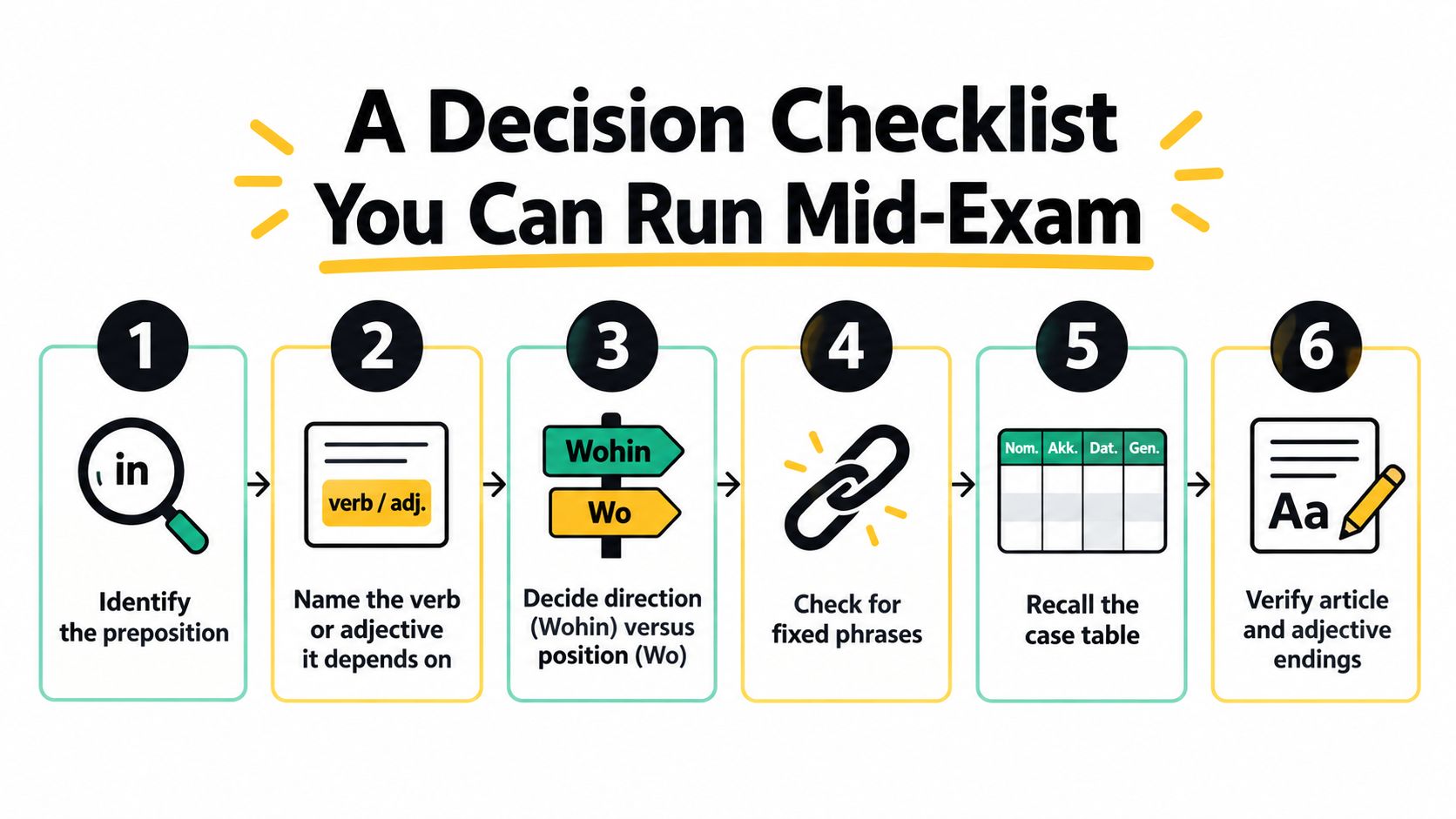
Use this six-step sequence when your mind goes blank:
- Identify the preposition. Is it accusative-only, dative-only, two-way or genitive?
- Name the verb or adjective it depends on. Is the phrase attached to gehen, liegen, helfen or another fixed expression?
- Decide direction or position. Ask Wohin? for movement and Wo? for a static location.
- Check for a fixed phrase. Some combinations, such as mit dem Bus, should be recognised as units.
- Recall the case table. Don't choose from the English translation alone.
- Verify the article and adjective endings. Check den, dem, der, des, then inspect the noun and adjective.
Try the flow under time pressure:
- Ich packe die Tasche für den U-Bahn-Weg. für selects accusative, so den U-Bahn-Weg is correct.
- Ich sitze in dem Café. Sitting describes a static location, so in dem Café is dative. The contracted form im Café is also possible.
Before opening a DSE or IB writing section, recite: preposition, verb, Wohin or Wo, case, article, register.
Contracted Forms im, am, ins, ans and When to Use Them
German combines several prepositions with a definite article. Recognising the pattern helps you read faster, but producing the form requires you to know the original case first.
| Preposition + article | Contracted form | Spoken | Formal writing |
|---|---|---|---|
| an + dem | am | safe | generally safe |
| an + das | ans | safe | use full form when register demands it |
| in + dem | im | safe | generally safe |
| in + das | ins | safe | use full form when formal clarity is preferred |
| auf + das | aufs | safe | usually informal or neutral |
| über + das | übers | safe | usually informal or neutral |
| vor + das | vors | safe | usually informal or neutral |
| hinter + das | hinters | safe | usually informal or neutral |
| neben + das | neben das, rarely contracted | uncommon | full form |
| zwischen + das | zwischens | uncommon | full form |
| zu + dem | zum | safe | generally safe |
| zu + der | zur | safe | generally safe |
| von + dem | vom | safe | generally safe |
| bei + dem | beim | safe | generally safe |
Group them by the preposition:
- an: am, ans
- in: im, ins
- auf: aufs
- über: übers
- vor: vors
- hinter: hinters
- zu: zum, zur
- von: vom
- bei: beim
The contraction doesn't alter the case. ins Kino still contains in + das Kino, so it expresses accusative direction. im Kino contains in + dem Kino, so it expresses dative location.
For the Goethe B1 Schreibteil and IB Paper 1, full forms can be a safer choice in formal letters, articles and reports when the task calls for a formal register. Contractions are not automatically wrong, but you should use them deliberately rather than importing every spoken form into written work.
Ten Exam-Style Practice Items With Worked Answers
Complete each sentence before looking at the answer. The items suit the grammar level commonly practised for Goethe A2/B1, IGCSE and IB Ab Initio or SL.
Drill block one
- Ich gehe ___ den Park. (durch)
- Sie fährt ___ dem Bus zur Arbeit. (mit)
- Wir legen das Buch ___ den Tisch. (auf)
- Das Buch liegt ___ dem Tisch. (auf)
- ___ des Semesters schreibt er viele Berichte. (während)
Answers
- durch den Park. durch takes accusative, so the masculine article is den.
- mit dem Bus. mit always takes dative, giving dem.
- auf den Tisch. legen describes movement or placement, so auf takes accusative.
- auf dem Tisch. liegen describes a static position, so auf takes dative.
- Während des Semesters. während takes genitive in this formal construction, so the neuter noun phrase uses des.
Common mistake to avoid: Don't let the English preposition decide the case. Identify the German preposition first.
Drill block two
- ___ der Prüfung bleibt sie ruhig. (trotz)
- Ich gehe ___ Kino. (in das)
- Wir sitzen ___ Café. (in dem)
- Er spricht ___ ihnen. (mit)
- Ich ___ die Tasche unter den Tisch. (stelle)
- Trotz der Prüfung. trotz takes genitive, and the feminine form is der.
- ins Kino. in das expresses direction, so it contracts to ins and remains accusative.
- im Café. in dem expresses location, so it contracts to im and remains dative.
- mit ihnen. mit requires dative, and ihnen is the dative plural pronoun.
- stelle. stellen describes a change of position, so unter den Tisch is accusative.
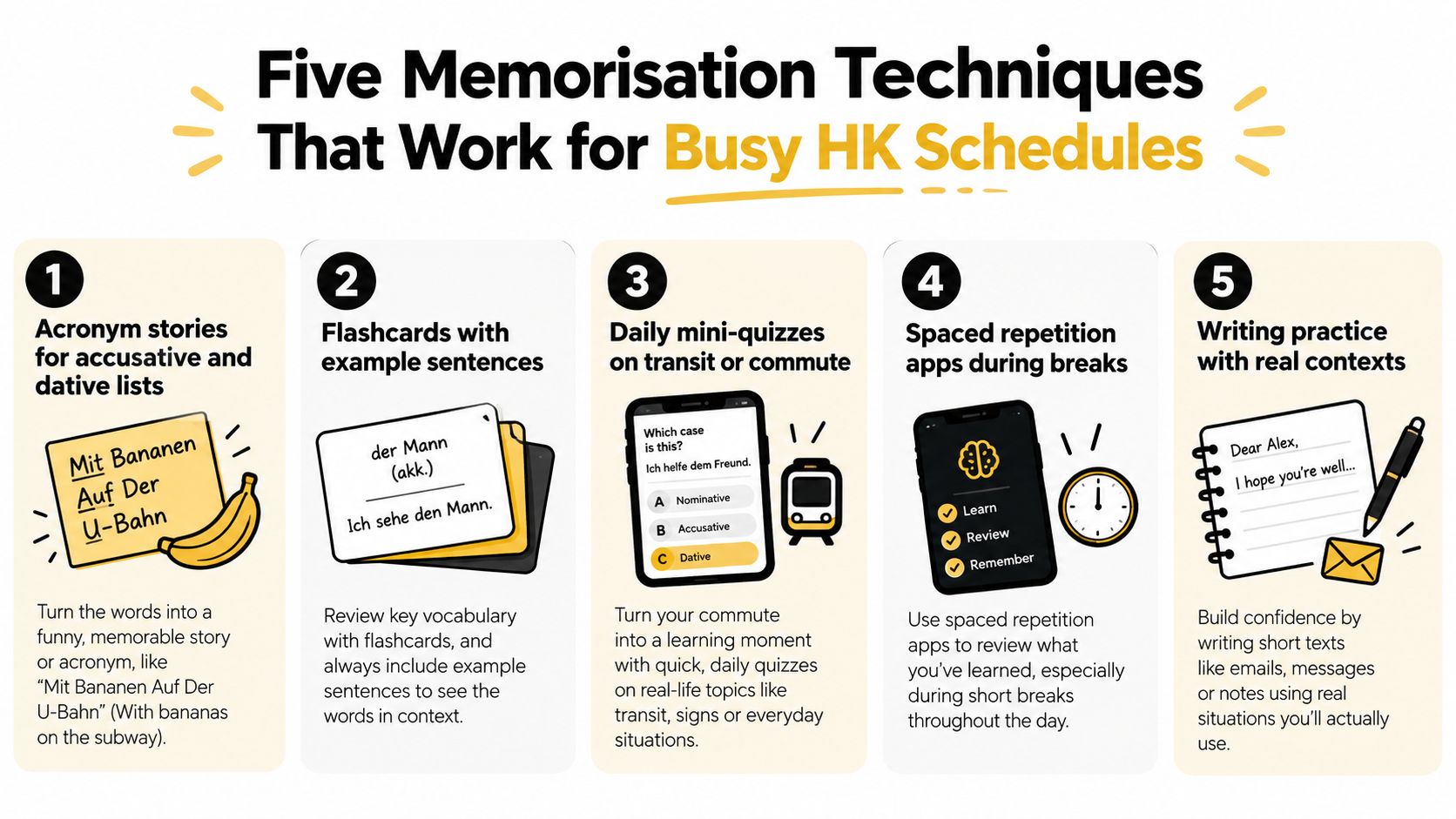
Build acronym stories. Use a phrase for the dative set, such as “Mit Bananen Auf Der U-Bahn”, and rehearse it during an MTR commute. Make the sentence memorable enough that it brings the prepositions back quickly.
Colour-code article charts. Put accusative, dative and genitive forms in separate colours inside your German notebook or MTR book. A visual der, den, dem, des sequence can be faster to scan than a paragraph.
Write one sentence each day. On the commute or before Saturday tuition, write one sentence using a different preposition group. Rotate through a work email, a travel plan and a classroom description.
Order digital cards by case. Arrange Anki or Quizlet decks by accusative, dative, two-way and genitive categories, not alphabetically. If you're comparing apps, this guide to the best spaced repetition tools 2026 can help you choose a practical system.
Use physical spatial flashcards. Walk into a kitchen and say in die Küche, then stand still and say in der Küche. The physical contrast gives the Wohin and Wo distinction a concrete reference.
Answers
Common mistake to avoid: For stellen, legen and setzen, focus on the change into a position, not the final position itself.
Five Memorisation Techniques That Work for Busy HK Schedules
Short, regular practice works better than one long revision session before an exam. Give the case patterns time to become familiar through repeated reading, speaking and writing.
Frequent Questions and Your Next Step in German
Do the case rules apply to speaking as well as writing?
Yes. The same case choices apply in every register, including Goethe speaking parts. You may hear more contractions in conversation, but mit dem Freund still requires dative, and in die Schule still requires accusative for movement.
Which categories deserve the most attention for DSE, IGCSE, IB and TestDaF?
Give particular attention to dative prepositions and two-way prepositions because they require accurate article choice and, for two-way prepositions, an interpretation of movement or location. Genitive becomes increasingly relevant for formal writing and university reading.
Can a two-way preposition take either case in the same sentence?
It can take either case in different contexts, but not as a random choice. The verb and meaning determine the case. Ich gehe in die Klasse describes direction, while Ich bin in der Klasse describes location.
Can spoken German use von plus dative instead of a genitive preposition?
Yes, von + dative is common in speech for some relationships. In a formal written examination, however, use an appropriate genitive construction when the sentence and register call for it.
Download the free GCA printable case-table PDF and book a diagnostic lesson before your next exam sitting. A teacher can identify whether your main difficulty is article endings, two-way prepositions, contractions or genitive writing, then turn that diagnosis into focused practice.
German Cultural Association Hong Kong(GCA) offers structured German lessons for beginners through advanced learners, with native-speaking teachers, small-group or private formats, and preparation for Goethe-Zertifikat, TestDaF, IGCSE, A-level and IB. Visit German Cultural Association Hong Kong(GCA) to download the printable case table, arrange a diagnostic lesson and check the latest course schedule.
German Prepositions: Which Case Does Each One Take? Complete Tables
German Accusative Case Explained: When and How to Use Akkusativ


