.png)
.png)

BLOG

香港德國文化協會
The German Cultural Association
German Accusative Case Explained: When and How to Use Akkusativ
You're writing an email to a German university, preparing for an IGCSE or Goethe-Zertifikat task, or just trying to say “I see the man” without hesitating over der and den. Many Hong Kong learners discover at this point that memorising vocabulary isn't enough. You also need to recognise the role each noun plays in a sentence.
This German Accusative Case Explained: When and How to Use Akkusativ guide focuses on the practical decision you need in real speech: identifying the direct object, changing the right article, and choosing accusative rather than dative when movement or a verb requires it.
Table of Contents
- Step one, identify the subject and object
- Step two, apply the indefinite article pattern
- Step three, learn the pattern with the verb
- Start with high-frequency verbs
- Memorise the accusative preposition group
- Decide between accusative and dative with two-way prepositions
Why the German Accusative Case Matters for Hong Kong Learners
A learner in Hong Kong may know Ich sehe means “I see”, and Mann means “man”, but still produce Ich sehe der Mann. The vocabulary is correct, yet the sentence is grammatically wrong because der Mann receives the action of seeing. German requires the masculine article to change to den.
The solution isn't to memorise a large table without context. Start by asking what the verb affects. If the answer is a person or thing receiving the action, that noun is usually the accusative direct object.

German learning in Hong Kong
German has a small but established learning pathway in Hong Kong. A Hong Kong University academic paper on German teaching recorded that only two local Chinese schools offered German as an official elective. In the 2016/2017 school year, 90 students enrolled in German, compared with 164 in French and 132 in Japanese.
The same paper recorded 100 teaching units per term for each class, with assessment through written tests, presentations, and oral examinations. That history matters because it shows that German grammar in Hong Kong has been taught through organised, systematic learning rather than casual phrase memorisation.
The broader learner base has also expanded in tertiary and continuing education. A DAAD Hong Kong system analysis reported that German learners, including many students, rose from about 4,000 per year before 2012 to more than 9,000 in 2014. The same analysis noted that German generally wasn't taught in Hong Kong schools, apart from the main exception of GSIS.
Practical rule: Learn Akkusativ as a sentence function first, then learn the article change. Ask, “Who or what receives the action?”
For adults, parents, and professionals, this foundation supports more than exam marks. It helps you write clearer emails, understand German reading passages, and speak with less hesitation when travelling, applying to study abroad in Germany or Spain, or handling international work.
Understanding the Basics of Akkusativ
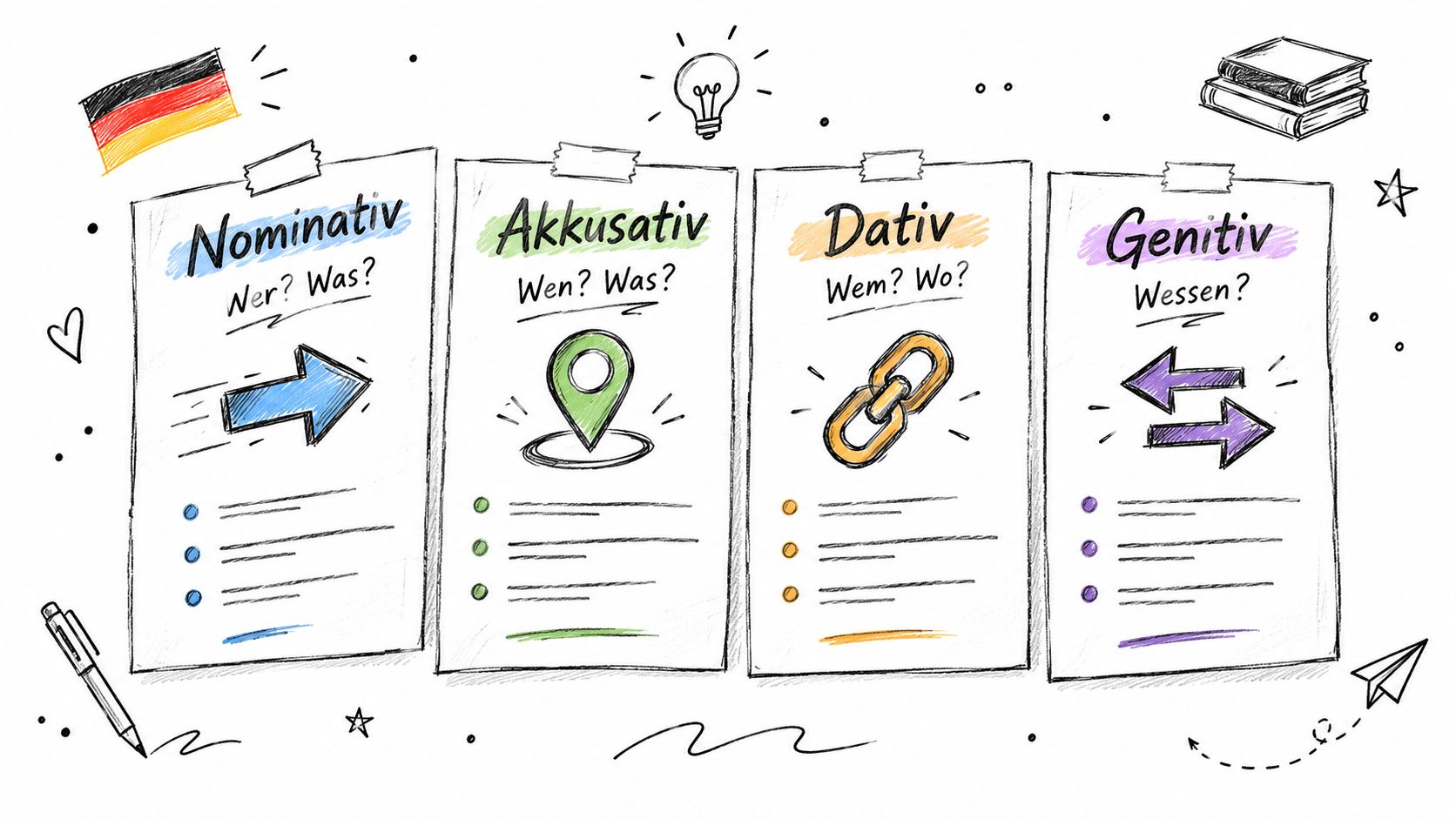
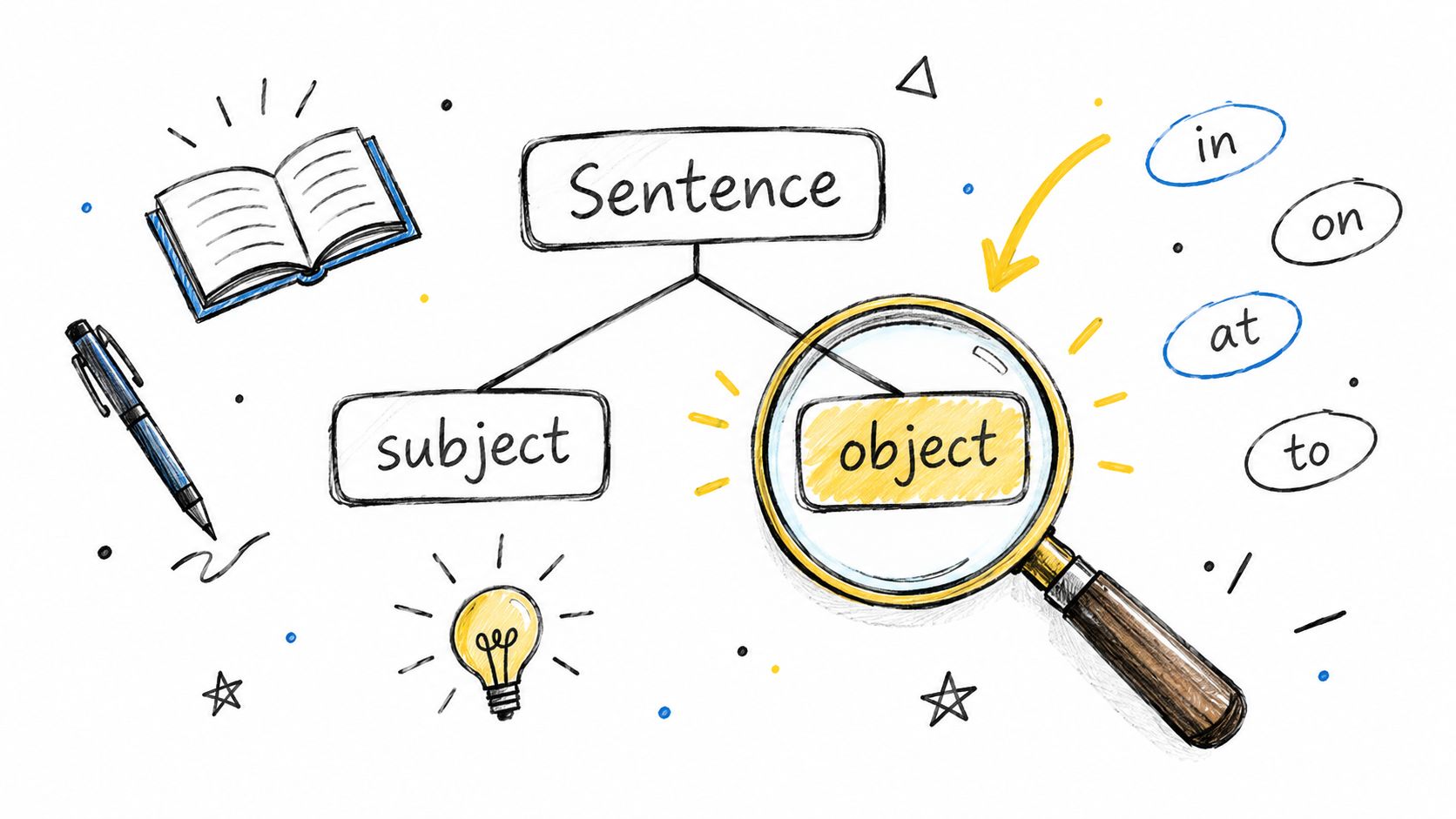
The accusative case marks the direct object, the person or thing receiving the verb's action. To find it, ask Wen?, meaning “whom?”, or Was?, meaning “what?”. German has four core cases, nominative, accusative, dative, and genitive, and Akkusativ is the case most often introduced after the subject role becomes familiar. A clear guide to the German accusative case uses this direct-object function as the starting point.
Step one, identify the subject and object
Take this sentence:
Ich sehe den Mann.
I see the man.
- Ich is the subject. It performs the action, so it's nominative.
- sehe is the verb.
- den Mann receives the action, so it's accusative.
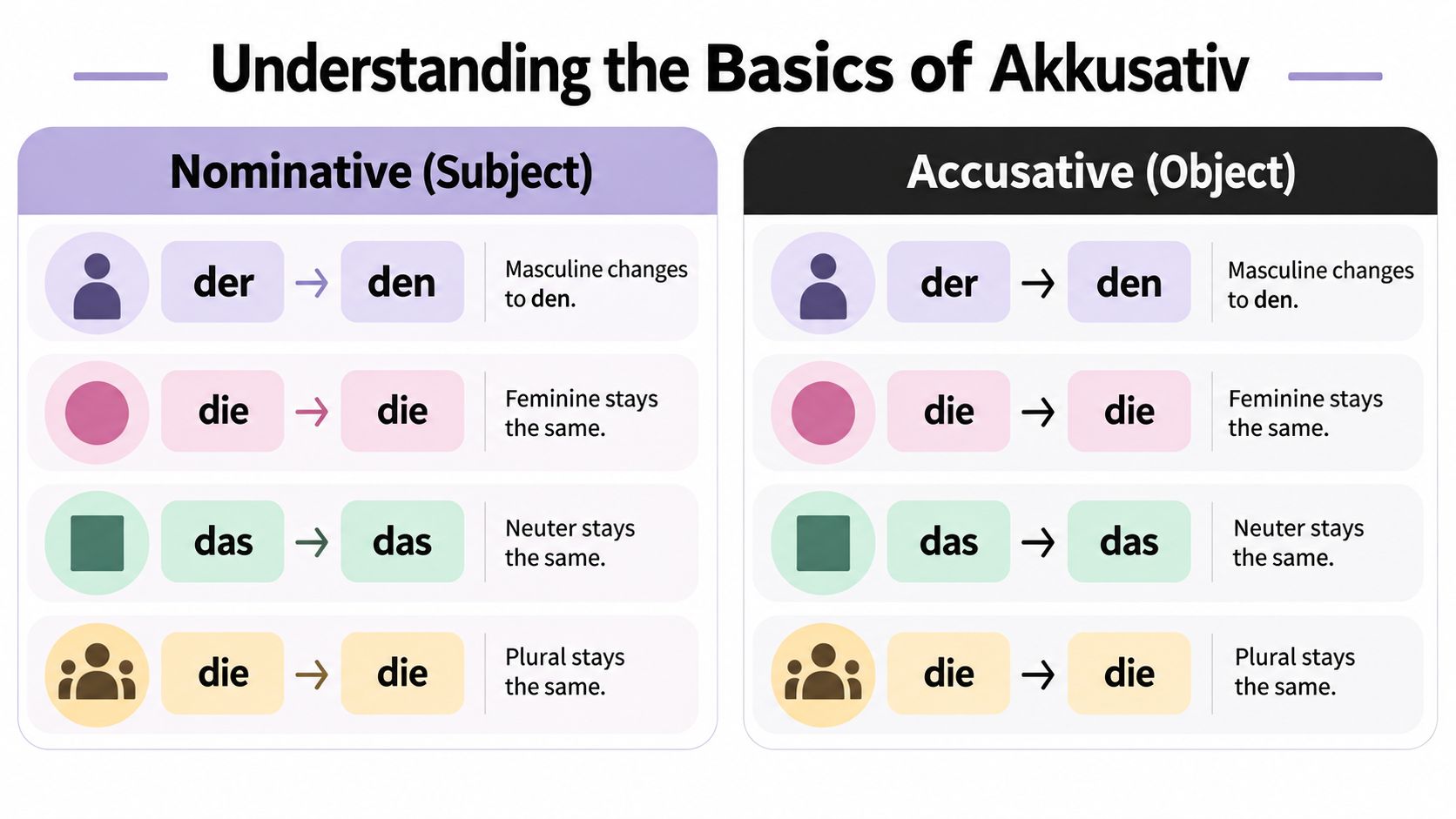
The article gives you an important clue. For masculine singular nouns, the definite article changes:
| Gender or number | Nominative | Accusative |
|---|---|---|
| Masculine | der Mann | den Mann |
| Feminine | die Frau | die Frau |
| Neuter | das Kind | das Kind |
| Plural | die Kinder | die Kinder |
Only the masculine article visibly changes in this basic pattern. That doesn't mean the other forms are unimportant. It means feminine, neuter, and plural nouns can conceal the case change, making them easy to overlook.
Step two, apply the indefinite article pattern
The same principle applies to indefinite articles:
- ein Mann becomes einen Mann
- eine Frau stays eine Frau
- ein Kind stays ein Kind
Compare these examples:
- Ein Mann liest ein Buch. A man is reading a book.
- Ich sehe einen Mann. I see a man.
- Sie kauft ein Buch. She buys a book.
- Wir besuchen eine Freundin. We visit a female friend.
The visible change appears in einen, because Mann is masculine singular and functions as the object.
Step three, learn the pattern with the verb
Don't practise der and den as isolated forms. Put them into short verb frames:
- Ich sehe den Lehrer. I see the teacher.
- Ich kaufe das Buch. I buy the book.
- Sie trinkt die Milch. She drinks the milk.
- Er hat einen Hund. He has a dog.
This sentence-based method is also the focus of a beginner guide to German grammar, which is useful when you need to connect article forms with everyday sentence construction.
Common Challenges for Cantonese Speakers Learning German
Cantonese-speaking learners often understand the meaning of a sentence before they notice its grammatical marking. In Cantonese, nouns and articles don't show the same kind of case inflection found in German. English also depends heavily on word order, so learners may rely on position rather than checking whether an article identifies the object.
That creates a predictable error:
- Incorrect: Ich sehe der Mann.
- Correct: Ich sehe den Mann.
The learner knows that Mann means “man” and sehen means “to see”. The missing step is recognising that the man is the direct object.
Why the easy-looking forms cause problems
Akkusativ can seem simple because only masculine singular articles change in the most familiar examples. That apparent simplicity creates a trap. Learners may practise den and einen but fail to notice accusative in feminine, neuter, and plural phrases because the article looks unchanged.
For example:
- Ich sehe die Frau. I see the woman.
- Ich sehe das Kind. I see the child.
- Ich sehe die Kinder. I see the children.
The noun phrase is still accusative, even though the article doesn't visibly change. The question remains the same: Wen? or Was?
A Cantonese-friendly decision routine
Use this routine whenever you build a sentence:
- Find the verb. What action is taking place?
- Find the person or thing doing it. That's usually the nominative subject.
- Ask Wen? or Was? The answer is the direct object.
- Check the noun's gender. Change the article if the noun is masculine singular.
- Check for a preposition. It may determine the case instead.
Hong Kong learners also need to separate rule knowledge from instant selection. In a classroom exercise, you have time to analyse. In a conversation about buying a ticket, entering a shop, or asking for directions, you need a short mental routine.
A guide to Chinese speakers learning German can support broader awareness of transfer issues, but the most useful practice is still targeted contrast. Repeat pairs such as Ich sehe den Mann and Ich helfe dem Mann, then ask why the article changes in one sentence but not the other.
Essential Verbs and Prepositions for Accusative
Many common German verbs take a direct object. Build confidence by learning the verb and its sentence frame together, rather than memorising a verb on its own.

Start with high-frequency verbs
Practise these patterns:
- sehen, to see: Ich sehe den Lehrer.
- kaufen, to buy: Ich kaufe das Buch.
- haben, to have: Er hat einen Hund.
- besuchen, to visit: Wir besuchen die Freundin.
- brauchen, to need: Sie braucht deine Hilfe.
- lieben, to love: Sie liebt ihn.
Pronouns also change in the accusative:
- ich becomes mich
- du becomes dich
- er becomes ihn
- wir becomes uns
- ihr becomes euch
So you'll say Der Lehrer lobt mich, meaning “The teacher praises me”, and Sie liebt ihn, meaning “She loves him”.
Memorise the accusative preposition group
These prepositions always take accusative:
- durch, through
- für, for
- gegen, against
- ohne, without
- um, around or at
Examples make the pattern easier to retain:
- Wir gehen durch den Park. We walk through the park.
- Das Geschenk ist für die Mutter. The gift is for the mother.
- Er spielt gegen den Meister. He plays against the champion.
- Ich arbeite ohne deine Hilfe. I work without your help.
- Das Treffen beginnt um acht Uhr. The meeting begins at eight o'clock.
Notice durch den Park and für die Mutter. The preposition tells you to use accusative, even before you consider the verb.
Decide between accusative and dative with two-way prepositions
The difficult decision often involves in, an, auf, hinter, neben, über, unter, vor, and zwischen.
Use accusative for movement towards a destination:
- Ich gehe in den Supermarkt. I'm going into the supermarket.
- Der Ball rollt unter den Tisch. The ball rolls under the table.
Use dative for a fixed location:
- Ich bin in dem Supermarkt. I'm in the supermarket.
- Der Ball liegt unter dem Tisch. The ball is under the table.
Ask Wohin?, “where to?”, for movement and direction. Ask Wo?, “where?”, for location. This distinction is especially important in spoken German because choosing the wrong case can make a familiar sentence sound uncertain.
Accusative vs. Nominative, Clearing Up Confusion
Nominative and accusative answer different questions. Nominative identifies the subject, the person or thing performing the action. Accusative identifies the direct object, the person or thing receiving it. The distinction is also used in exam-focused guidance on nominative and accusative.
Compare the two sentence roles:
| Sentence element | Question | Example |
|---|---|---|
| Nominative subject | Who performs the action? | Ich sehe den Mann. |
| Accusative object | Whom or what does the action affect? | Ich sehe den Mann. |
Word order can make the difference less obvious. In Der Mann sieht den Lehrer, der Mann is the subject and den Lehrer is the object. The article signals the roles.
In a shorter sentence, the same principle applies:
- Die Frau kauft das Buch.
- Die Frau performs the buying action.
- das Buch is what she buys.
The feminine and neuter forms don't visibly change here, so use the questions rather than relying only on the article.
A quick test for sentence production
Before speaking or writing, run this check:
- Circle the verb.
- Underline the performer.
- Ask Wen? or Was?
- Mark the answer as accusative.
- Change der to den, or ein to einen, if the noun is masculine singular.
For a fuller introduction to the other case contrast, use this practical guide to dative and genitive for Hong Kong beginners. The purpose isn't to translate every German sentence into Cantonese or English. It's to identify the grammatical relationship directly.
Preparing for Exams with Accusative Mastery
Accusative accuracy supports German assessment across IGCSE, A-level, IB, Goethe-Zertifikat, and HKDSE Category C German. Hong Kong education pathways include HKDSE Category C German through Goethe-Zertifikat A2 or above, while German curricula may connect with internationally recognised IGCSE and AS-level examinations. The Goethe-Institut Hong Kong examination information is the appropriate place to check current requirements.
Tertiary progression also demands durable grammar. HKU SPACE indicates roughly 230 to 250 hours of prior study for upper-intermediate German progression, so learners need more than short-term memorisation. They need article changes, verb patterns, and word order to become reliable under time pressure.
Build a focused practice cycle
Use a compact routine that fits school, work, or family commitments:
- Recognition: Highlight every direct object in a reading passage.
- Transformation: Change nominative phrases into accusative phrases, such as der Mann to den Mann.
- Contrast: Pair movement and location, such as in den Park and in dem Park.
- Production: Write and say short sentences using sehen, kaufen, haben, and besuchen.
- Correction: Keep a personal list of repeated errors, especially der for den and accusative for fixed location.
For revision materials, combine official exam information with practical past papers and flashcards advice. Past-paper work shows how grammar appears in context, while flashcards help you retain article and pronoun forms between lessons.
Parents should check whether a course covers grammar through speaking and writing, not only worksheets. Working professionals may prefer short, regular practice focused on travel or business German. Learners considering study abroad in Germany should also check whether their chosen pathway requires a particular Goethe-Zertifikat level. CEF funding eligibility and course conditions can change, so verify the latest details before budgeting.
German Cultural Association Hong Kong(GCA) offers native-speaker German lessons, small-group and private classes, online Zoom sessions, and structured preparation for Goethe-Zertifikat, IGCSE, A-level, and IB exams. If you want guided practice choosing Akkusativ in real sentences, visit German Cultural Association Hong Kong(GCA) to contact an adviser and check the latest course schedule.
German Prepositions: Which Case Does Each One Take? Complete Tables
German Accusative Case Explained: When and How to Use Akkusativ


