.png)
.png)

BLOG

香港德國文化協會
The German Cultural Association
Timetable & Fees for German Lessons in Hong Kong
You've got a school run, a packed office calendar, and a German class you keep postponing because the timing never quite works. That's the main problem for most learners in Hong Kong, not motivation. The right Timetable & Fees setup should fit your life first, then your budget, not the other way around.
If you're comparing German lessons in Hong Kong right now, use this as a practical reference, not a brochure. It's built for parents, teens, and working adults who want a fast way to compare in-person and online schedules, understand what they're paying for, and decide whether a group class, private lesson, or exam track makes sense in HK.
Table of Contents
- Find Your Ideal German Class Time in Hong Kong Fast
- Start with the level, then the age band
- Match the timetable to the learning goal
Find Your Ideal German Class Time in Hong Kong Fast
You're probably trying to solve the same problem every busy Hong Kong learner faces. The timetable looks fine on paper, but once you add DSE, IB, university classes, MTR travel, overtime, or family commitments, the option stops being realistic.
The cleanest way to use this guide is to start with your life pattern, not the course name. If you need something fixed and local, look at the in-person options near Tsim Sha Tsui and Causeway Bay. If your week is unstable, the Zoom option is the safer choice because it removes commute pressure and gives you more room to keep learning in Hong Kong without missing lessons.
For most adults, the decision comes down to three questions. Can you attend a weekly evening block? Do you need weekend flexibility? Or do you need a timetable that survives business travel, family duties, and changing shifts? The right answer points you to the right mode faster than any fee list can.
This reference lays out the timetable logic, then matches it to fees, CEF funding, and booking rules. By the end, you should be able to decide which class format fits your schedule, what level you should enter, and whether the fee structure matches the value you need.
How Our Timetable System Works by Level and Age Group
Featured snippet answer. German timetables at GCA are organised by CEFR level, age band, and learning goal. That means you can choose a course for preschoolers, children, teenagers, or adults, then narrow it further by general German, exam preparation, or specialist tracks like Business German and Travel German. The system is built for fast matching, not guesswork.
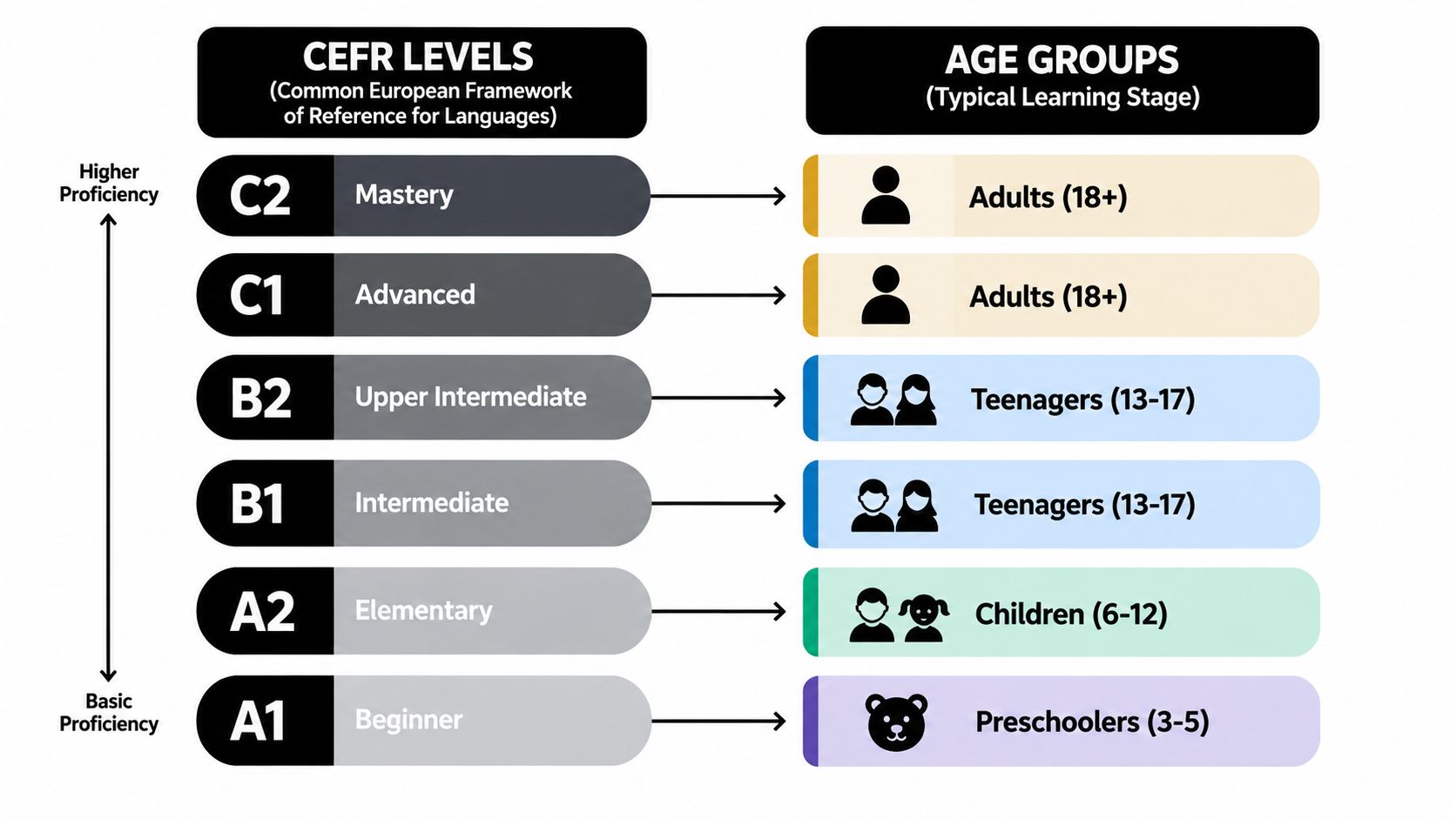
Start with the level, then the age band
Use A1 to C2 as the academic backbone. Then place the learner in the right age group so the pace, examples, and classroom style feel appropriate.
- Preschoolers, 3 to 5. Start here only if the child needs very light exposure, playful repetition, and short contact time.
- Children, 6 to 12. This is the main stage for foundational German, especially if parents want a stable weekly rhythm.
- Teenagers, 13 to 17. This group is usually better matched to structured progress, school support, and exam-linked lessons.
- Adults, 18 plus. Adults need the most flexible timetable logic because work hours, family commitments, and travel plans often change.
Match the timetable to the learning goal
The timetable should change depending on whether the student is learning for everyday use, school support, or an exam.
- General German works best when the learner needs stable progress without a deadline.
- Exam preparation suits students heading for Goethe-Zertifikat, TestDaF, IGCSE, A-level, or IB.
- Business German is for professionals who need formal communication, meetings, or client-facing language.
- Travel German is the right call when the main need is practical conversation for trips or relocation.
Practical rule: If the learner has a deadline, choose the exam track first. If there's no deadline, choose the age band and timetable pattern first.
The timetable matrix below makes this easier to use in seconds. Parents usually jump straight to the children and teen sections, while adults often compare weekday evening and weekend blocks first. If you want the format comparison, the next section covers it directly. If you want the pricing logic, skip ahead to the fee guide.
In Person and Online Timetables Compared
The timetable decision in Hong Kong is simple once you strip away the marketing language. If the learner needs face-to-face interaction, clear classroom discipline, and a fixed weekly routine, in-person classes are the better fit. If the learner needs fewer commute burdens and more freedom to shift around work or family obligations, Zoom wins.
Side by side timetable view
| Feature | In Person Centres | Online via Zoom |
|---|---|---|
| Location | Near Tsim Sha Tsui and Causeway Bay MTR access | Anywhere in Hong Kong with a stable connection |
| Flexibility | Fixed attendance pattern, best for learners who like routine | More adaptable for busy HK schedules |
| Interaction level | High, with direct teacher attention and classroom energy | High in a small-group format, with interactive live teaching |
| Suitability | Strong for children, teens, and learners who focus better on-site | Strong for adults, professionals, and families needing fewer commute constraints |
| Rescheduling | Less flexible than online | Easier to manage when work or family plans change |
The best online courses still need structure. For that reason, course teams should think carefully about enrolment logic, reminders, and make-up policies. If you're building a digital class flow, a practical guide like the Orbit AI course form builder is useful for understanding how structured online enrolment can keep the process clean for both school and learner.
For Hong Kong parents, in-person is usually the safer choice for younger children because it creates a firmer routine. For professionals, online often makes more sense because a late meeting or a client dinner doesn't destroy the whole week. That's also why the timetable needs to be read together with the fee structure, not as separate documents.
In Hong Kong, convenience isn't a luxury. It's the difference between a course that gets completed and one that gets abandoned after a few weeks.
If you want a deeper format comparison, the internal guide on in-person versus online German classes in Hong Kong is the right next read. Use it to decide whether your learner needs classroom discipline or timetable freedom more.
Complete Fee Guide for Group Private and Exam Courses
Hong Kong buyers compare German fees in a very specific way. They look at total price, yes, but they also look at hours, group size, and contact intensity. That's why small-group German often feels expensive until you divide it properly by teaching time and compare it with private tutoring.
Fee comparison by format
| Course Type | Total Fee | Hours | Hourly Rate |
|---|---|---|---|
| Standard group course | HK$2,500 to HK$4,000 | 25 to 30 | About HK$90 to HK$160 |
| Online group course | HK$2,200 to HK$3,500 | 25 to 30 | About HK$73 to HK$140 |
| Private tuition | HK$400 to HK$800+ per hour | Per hour | HK$400 to HK$800+ |
| Introductory certificate track | HK$9,550 | 120 | About HK$80 |
| HKU SPACE certificate benchmark | HK$9,550 to HK$10,450 | 120 | About HK$80 to HK$87 |
| Short academic German course | HK$1,900 to HK$3,750 | Varies | Varies |
| Local age-based group cycle | HK$1,100 to HK$4,180 | Four weeks to eleven weeks | Varies |
The local market data consistently shows a premium for one-to-one instruction, with private tuition typically 4 to 8 times more expensive than group study on an hourly basis. Standard group courses in Hong Kong commonly sit around HK$2,500 to HK$4,000 for 25 to 30 hours, while private lessons run HK$400 to HK$800+ per hour. That is not a small gap, and it matters if you're paying from a family budget or just want value without wasting contact time. See the broader local pricing context in the 2026 Hong Kong German course price guide.
What the fee structure tells you
A higher fee isn't automatically a worse deal. A compact, structured class with a native teacher can be better value if the learner needs correction, pacing, and accountability.
- Group classes suit parents and teens who need structure without paying private rates.
- Private lessons make sense when the learner has a sharp deadline or a very specific gap.
- Certificate tracks work well for serious learners who want a clear academic path.
- Business German is usually best for adults who need formal output, not casual conversation.
For readers who care about transparent pricing systems in general, the idea is the same across sectors. A clear fee page should show the unit cost, not bury it in marketing language. A good pricing reference such as find Transparent pricing is useful because it makes the underlying value visible fast.
GCA's own model sits in the premium structured category, which is exactly where serious learners in Hong Kong tend to look when they want native-led instruction, a defined curriculum, and exam preparation that's not improvised. That matters more than a low headline price.
How Much Does It Cost After CEF Funding
The Hong Kong Continuing Education Fund, CEF, changes the equation for many adult learners. The maximum subsidy is HK$25,000, with reimbursement at 80% of the first HK$10,000 and 60% of the remaining HK$15,000. In plain terms, your co-payment is 20% on the first tier and 40% on the second tier. See the official reimbursement structure in the CEF expenses guide.
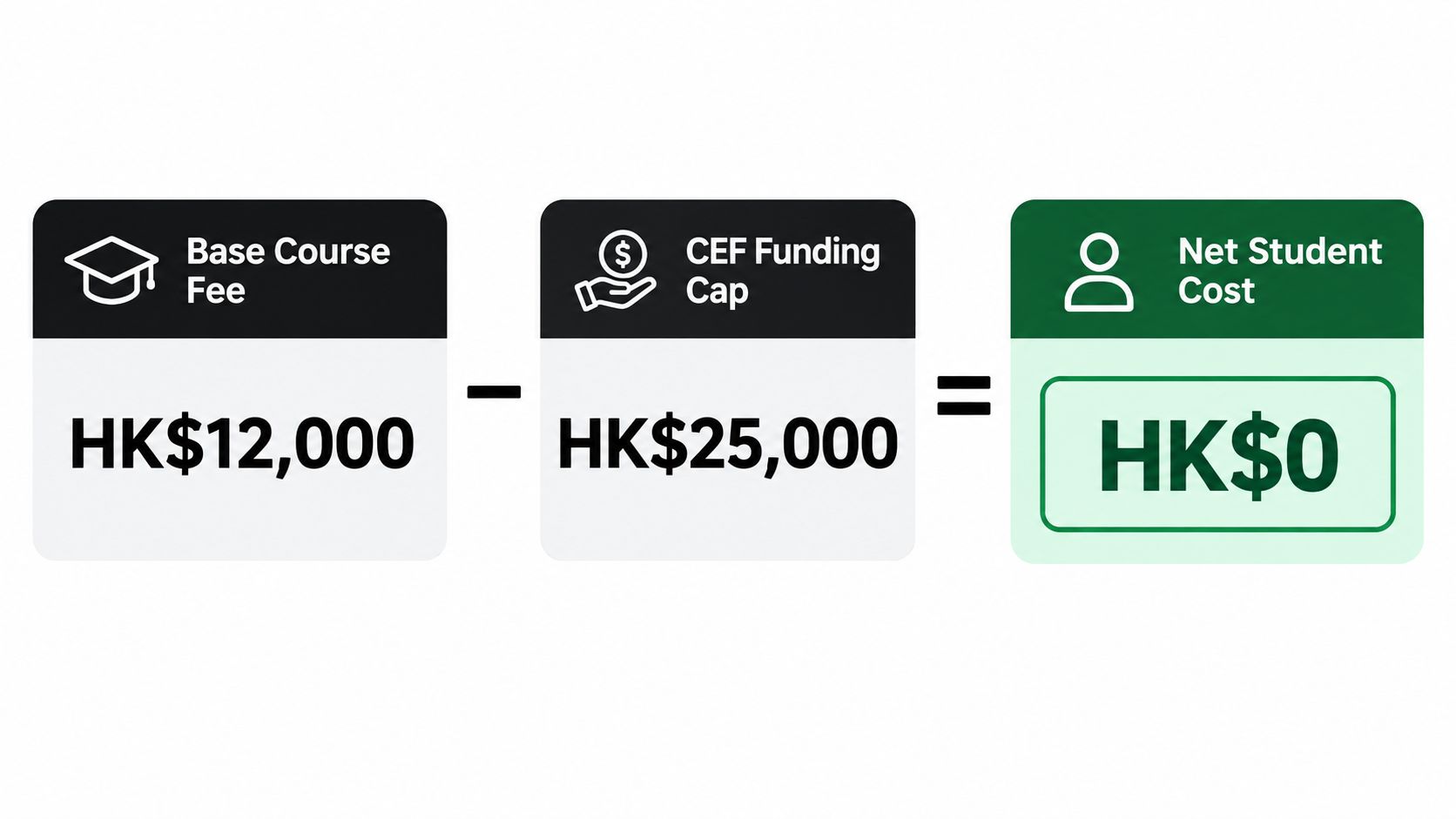
How to read the subsidy
The math is straightforward.
- First HK$10,000 of approved fees. The fund pays 80%, so the learner pays 20%.
- Next HK$15,000 of approved fees. The fund pays 60%, so the learner pays 40%.
- Anything above HK$25,000. That amount is outside the subsidy cap.
For example, if an approved German course costs HK$12,000, the first HK$10,000 follows the 80/20 rule, and the remaining HK$2,000 follows the 60/40 rule. The final out-of-pocket amount is lower than the sticker price because part of the fee is reimbursable under the scheme.
Who can use it
CEF eligibility is aimed at Hong Kong residents aged 18 or above at the time the course starts, regardless of education level, employment status, or financial status, as long as the person meets the relevant right-of-abode requirements. That makes it relevant for working adults, parents returning to study, and people planning a career shift in Hong Kong. The broader eligibility rules are set out on the official CEF eligibility page.
Some German programmes are approved for CEF, but the course still has to be completed properly. HKU SPACE states that students must attend at least 70% of lessons, pass with at least 50% of marks, take a recognised benchmark exam such as Goethe-Zertifikat A1 or B1, and submit the claim within one year after course completion or the benchmark exam date, whichever is later. The programme rules are explained in the HKU SPACE CEF German course page.
If a course is CEF-eligible, don't look only at the gross fee. Look at attendance rules, assessment rules, and claim timing first. That's where many adults get caught out.
For a more detailed funding overview, the complete guide to CEF-funded German courses in Hong Kong is the right place to check course-level eligibility before you commit.
Discounts Payment Options and Booking Policies Explained
Commercial terms matter because they affect whether a learner finishes the course. In Hong Kong, the smartest families and professionals don't just ask about level and price, they ask about how the booking slot is protected, what happens if someone misses class, and how quickly they can shift a timetable if work changes.
What to check before paying
- Payment method. Ask whether the fee is paid per term, by package, or by instalment if available.
- Discount eligibility. Confirm whether a multi-course or early-enrolment discount applies before you submit the booking.
- Class lock-in. Check how long the chosen timetable slot stays reserved.
- Attendance certificate rules. If the course is certificate-based, ask what attendance threshold applies before you start.
- Rescheduling policy. For online learners especially, clarify how easily a session can be moved.
What the rules mean in real life
If a child misses two sessions, the family should not assume the lessons can be recovered automatically. Under a structured certificate system, the attendance record still matters, and repeated absences can affect whether the learner meets the course requirement.
If a professional needs to move a weekday evening class, online delivery is usually easier to manage than a fixed in-person slot. That is exactly why the timetable choice should come before payment, not after it.
Practical rule: Book the timetable only after you know the attendance threshold and the rescheduling window. That avoids unnecessary disputes later.
How to secure a place properly
A strong booking process should do three things. It should confirm the learner's level, secure the right timetable, and make the policy clear before the first class starts. If the course has exam preparation attached, ask how the benchmark exam fits into the schedule so nothing is left to guesswork.
For parents, that means checking whether the child can realistically attend every week during exam season or activity season. For adults, it means making sure the course doesn't collapse the first time a meeting runs late.
Choosing the Right Course With Cross References and Examples
The right choice is not “the cheapest course” or “the most intensive course”. It's the course that matches age, timetable, and purpose. That is why parents, teens, and working adults should use different filters before they enrol.
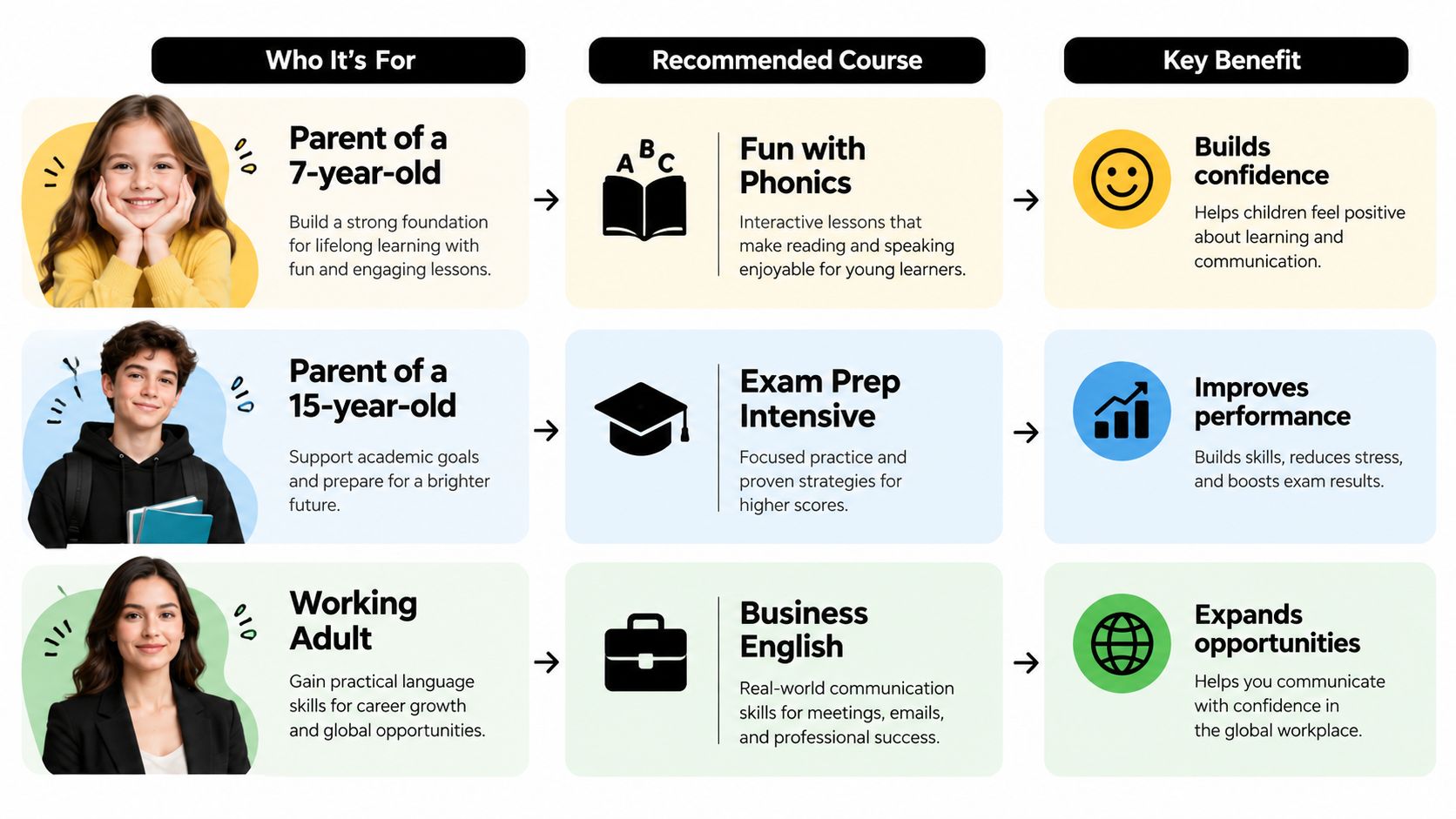
Decision matrix for HK learners
| Goal | Recommended Format | Timetable Pattern |
|---|---|---|
| Child foundation learning | Small-group class | Weekly fixed block, after school or weekend |
| Teen exam preparation | Exam track | Consistent term-based schedule |
| Adult relocation or travel | General or Travel German | Evening or weekend class |
| Business communication | Business German | Regular weekday evening block |
| Strong exam ambition | Structured certificate track | Compact timetable with clear milestones |
Parents of younger children should read the timetable with the fee guide next to it. Children respond well to stability, so the in-person or small-group route is usually more practical than a loose, irregular schedule. Parents of teenagers should focus on the exam track and the contact hours, especially if the student is working towards Goethe-Zertifikat, IB, or another school-linked outcome.
Adults planning study abroad in Germany need a very different lens. They need a timetable that can survive work, visa prep, and document deadlines, so the more modular course is often the better fit. Professionals needing Business German should not settle for general conversation classes if their goal is client communication or a formal workplace environment.
The strongest programmes combine native-speaking teachers, small groups, and a curriculum that follows an exam path instead of random classroom topics.
That is also why some learners prefer a structured association model like the German Cultural Association Hong Kong(GCA), because the timetable can be matched to age, level, and exam target without losing academic discipline. If your goal is serious progress rather than casual exposure, that structure matters more than gimmicks.
Quick Reference Lookup and Ready to Start Learning
Use this as your fast decision sheet.
| Age Band | Level | Best Fit |
|---|---|---|
| Preschoolers | A1 to A2 | Gentle introduction, short and stable timetable |
| Children | A1 to A2 | Weekly group classes with clear routine |
| Teenagers | B1 to B2 | School support and exam preparation |
| Adults | C1 to C2 | Advanced study, business use, or relocation goals |
| Fee Signal | What It Means |
|---|---|
| Around HK$90 to HK$200 per hour | Typical small-group value range in Hong Kong |
| HK$400 to HK$800+ per hour | Private one-on-one tuition |
Booking checklist
- Select the format. Choose in-person if routine matters more, or Zoom if flexibility matters more.
- Check CEF eligibility. Verify whether the course is approved before paying.
- Confirm the attendance rule. If it's certificate-based, don't guess the threshold.
- Match the timetable to the goal. General, exam, business, or travel.
- Contact an advisor early. The good slots go first, especially for weekend and evening blocks.
If you want a disciplined, structured route, check the latest course schedule, compare the timetable against your week, and book the format that fits your life. Parents, teens, and professionals in Hong Kong do best when they choose the schedule first, then the course, not the other way round.
German Cultural Association Hong Kong(GCA) offers structured German learning in Hong Kong with in-person and online options, exam preparation, and clear timetable planning for different age groups. Visit German Cultural Association Hong Kong(GCA) to check the latest course schedule, compare formats, and book a trial class with an advisor who can match the right level to your goal.

German Reading for Beginners: Graded Readers by CEFR Level

Costs and Language Requirements for German in HK


