


BLOG

香港德國文化協會
The German Cultural Association
German Reading for Beginners: Graded Readers by CEFR Level
You're on the MTR with a German novel open, but you're still translating page one when your stop arrives. For German reading for beginners: graded readers offer a more manageable starting point, whether you're fitting study around work or helping a teenager prepare for exams.
Table of Contents
- Give each pass a separate job
- Include the texts you meet outside stories
- Suggested 45-minute teen A2 session
- Suggested 20-minute adult plan over five days
- Suggested 15-minute parent-led plan four nights a week
- Activities that work at home and in class
What Are Graded Readers for German Beginners?
Graded readers are short German books written with controlled vocabulary and grammar, organised into levels aligned with CEFR stages from A1 to C2. They help learners recognise most words on the page, follow a story without constant translation, and gradually handle more demanding sentences, topics and text types.
Think of the levels as a staircase. Each step introduces a manageable selection of verbs, cases and sentence patterns, while keeping familiar language in use.
Say you recognise Ich kaufe Brot but struggle with weil ich noch Brot kaufen muss. You don't necessarily need a more interesting novel. You need reading that makes the first pattern automatic while introducing the second with enough context to understand it.
Why shorter books help busy learners
- Faster recognition: Recurring core words across a series become familiar enough that you stop translating them.
- Manageable sessions: A short chapter fits a commute or lunch break without requiring you to reconstruct a complicated plot.
- Input between lessons: Reading keeps you in contact with German when opportunities for conversation are limited.
Hong Kong has an established German-learning community: the Goethe-Institut Hongkong's course brochure reported approximately 3,000 learners annually across adults, teenagers and children. Beginner materials therefore need to serve different goals, not just different ages.
A finished reader is evidence of reading practice, not a substitute for speaking, writing or Goethe-Zertifikat task preparation.
The useful starting question isn't which story looks most impressive. It's which page you can understand independently, and what you need German for.
Matching Your CEFR Level to the Right Reader
Choose by sentence complexity and comprehension first; use vocabulary counts only as rough purchasing guides, not official CEFR requirements.
CEFR levels, reader features and exam benchmarks
| CEFR level | Approximate vocabulary | Sentence and text features | Exam benchmark |
|---|---|---|---|
| Pre-A1 picture readers | Familiar names, objects and everyday actions | Single sentences, heavy illustration, familiar objects | None, informal placement |
| A1 | About 500 words as an illustrative publisher-style guide | Short clauses, present tense, signs, notices and posters | Goethe-Zertifikat A1: Start Deutsch 1 |
| A2 | About 1,000 to 1,500 words as an illustrative publisher-style guide | Connected paragraphs, past-time reference, modal verbs, everyday transactions | Goethe-Zertifikat A2; HKDSE German Category C certificate pathway |
| B1 | About 2,000 to 2,500 words as an illustrative publisher-style guide | Longer narratives, opinions, multi-paragraph texts | Goethe-Zertifikat B1 |
These illustrative vocabulary bands describe possible controlled word inventories, not total book length or guaranteed learner vocabulary. Publishers count words differently, so a level label and a sample chapter tell you more than a number alone.
Understand what changes between levels
Pre-A1 readers let the illustration carry much of the meaning. A sentence such as Das ist ein Hund connects a visible object with a familiar structure.
At A1, learners follow brief actions and predictable exchanges. A useful reader repeats everyday verbs across changing situations rather than introducing unfamiliar language in every sentence.
At A2, readers must connect information across sentences. A character might explain what happened yesterday, describe a problem and ask someone for help.
B1 introduces longer stretches of narrative and opinion. Recognising individual sentences is no longer enough: readers must follow reasons, attitudes and references across paragraphs.
Try a home placement check
- Open the first page without a dictionary. Read it through and identify who is involved, where they are and what happens.
- Notice the interruptions. If you need more than a handful of lookups just to follow events, try an easier level.
- Check understanding, not speed alone. Explain the page in your own words and check whether you missed a change of speaker or an important negative.
- Sample a harder book if it feels effortless. Move up only if comprehension remains comfortable, rather than because the easier book looks childish.
For a broader explanation of the progression, use the German CEFR levels guide for Hong Kong learners.
The Goethe-Institut Hong Kong examination guidance states that, from 2025, HKDSE German Category C candidates must pass a Goethe certificate at A2 or higher within the preceding two years. Treat that as a certification requirement, not a promise that an A2-labelled storybook provides complete exam preparation.
Mixed skills are normal. You might read comfortably at A2 while speaking at A1; choose your reader by reading ability and address spoken performance separately.
Choosing Series by Age, Exam Goal and Career Need
A good topic encourages you to continue, but it shouldn't determine placement. Choose the language stage first, then select material that supports the learner's intended use.
Match the text to the destination
- Children aged 6 to 10: Consider picture-led pre-A1 to A1 readers, adjusting for actual German experience. A parent can point to the relevant part of the picture while reading aloud, then let the child identify the person, object or action.
- Teenagers following IGCSE, A-level, IB or HKDSE German: Consider controlled fiction at A2 when placement supports it, with comprehension questions and separate timed tasks. Check whether activities require inference and explanation, rather than only copying words from the page.
- Adults preparing for travel, visas or work: Start with accessible A1 to A2 material involving forms, timetables, appointments and workplace dialogue. Choose situations you expect to handle, but verify visa-related language requirements separately rather than assuming every route requires the same certificate.
- Learners planning to study abroad in Germany: Add simplified academic-style texts at A2 to B1 as your reading develops. Course descriptions, student accommodation information and short explanatory passages are useful preparation, although university-level reading requires further progression.
The Hong Kong Government education factsheet lists 53 international schools offering non-local curricula, including German and the International Baccalaureate. For families, that makes syllabus matching important: a reader should support the language and response formats the student needs.
Check the edition before paying
Look at German publishers' graded-reader ranges from Hueber, Klett and Cornelsen. Choose a specific edition by its level, support materials and sample pages, not just the publisher's name.
- Search library holdings: Use the Hong Kong Public Libraries catalogue to look for German titles and reserve available copies.
- Check the ISBN: Confirm that the listing refers to the graded edition, not the original novel or a different workbook.
- Compare the delivered price: Include shipping and any applicable import costs, rather than comparing cover prices alone.
- Inspect the back cover: Look for the CEFR label, glossary arrangement, comprehension exercises and audio access.
- Try before committing to a series: Borrow or buy an initial volume before ordering a complete set.
A children's book written for native speakers isn't automatically easier than an adult graded reader. Familiar-looking pictures can hide unfamiliar idioms, rhymes and grammar.
Choosing Print, E-book or Audio for Your Level
A 2025 Hong Kong Publishers Association survey, collecting 1,414 responses, found that nearly 69% of respondents had read digitally during the previous year. That establishes familiarity with digital reading, not a reason to choose an e-book for every German learner.
Use this visual guide to compare the formats before buying.
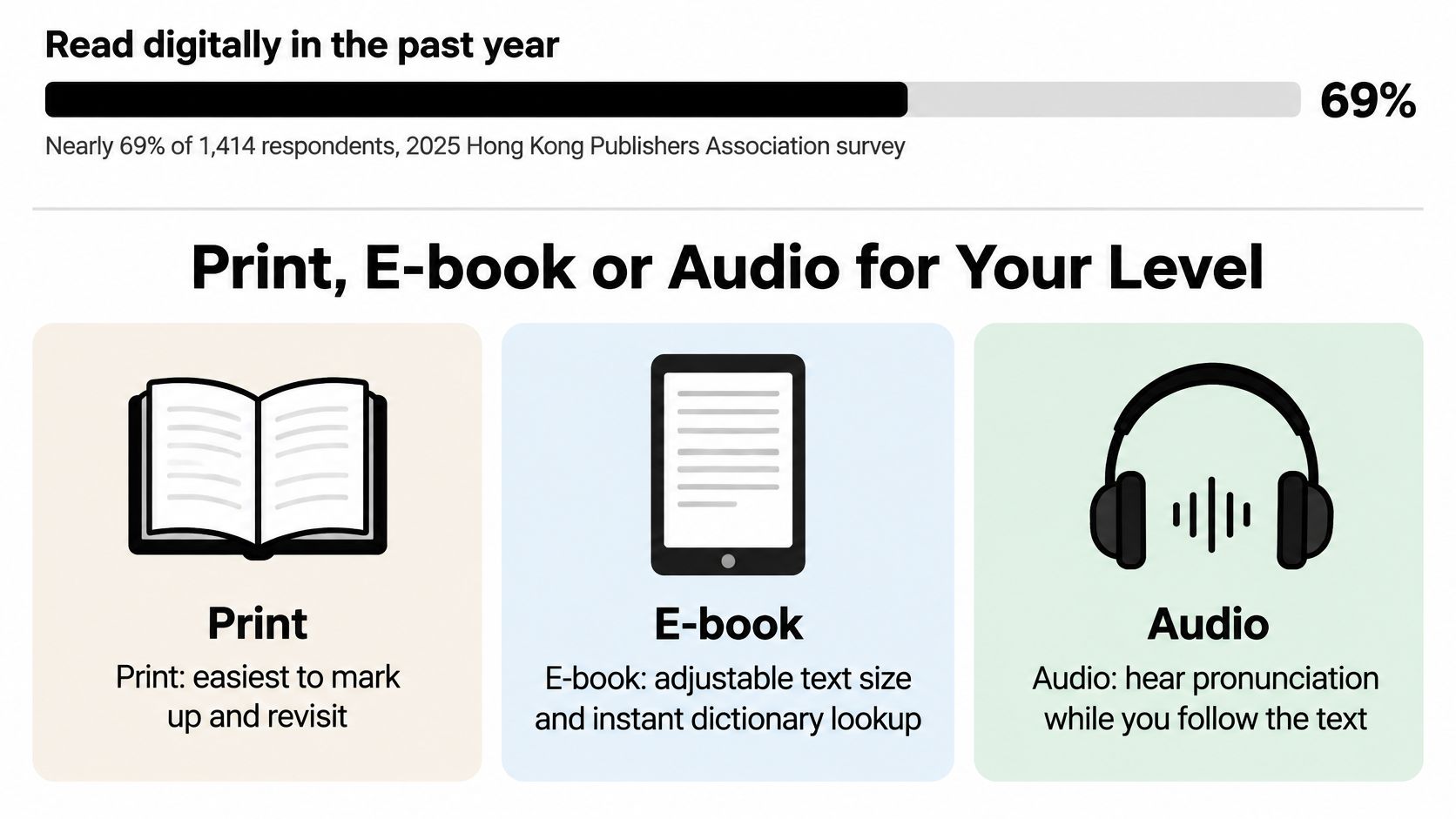
Reading format by learner type and trade-off
| Format | Best for | Main trade-off | Hong Kong note |
|---|---|---|---|
| Sustained focus, children and first-time readers | Heavier to carry; no built-in dictionary | Check local bookshops and library holdings; order from German publishers if needed | |
| E-book | Commuters, MTR reading, adjustable text size and dictionary access | Screen fatigue and the habit of tapping every unfamiliar word | Confirm that the platform sells German titles to Hong Kong accounts |
| Audio plus text | Pronunciation, listening practice and exam listening support | Easy to listen without reading closely | Confirm audio availability and download access with each publisher |
Use the format without letting it do the work
- Hide the dictionary after initial checking: During rereading, disable automatic translation or close the dictionary panel. Let the sentence supply meaning before tapping a word.
- Keep audio connected to print: Follow the text, notice how the words sound, then read without playback. Audio alone doesn't show whether you can decode the written passage.
Check device compatibility before purchasing, especially when audio requires a publisher's app or access code. Local library choices for German children's books can be limited, while younger learners may already spend substantial time on screens.
For German reading for beginners: graded readers often work well in a hybrid routine. Use print for focused reading, a digital copy when portability matters, and audio for targeted pronunciation work rather than continuous background listening.
Three-Pass Reading Routine and Sample Lesson Plans
Read the same short passage for different purposes instead of racing through new chapters. The first encounter establishes meaning; later encounters help you recognise language and retrieve it without the page.
Keep this routine visible beside your reading space.
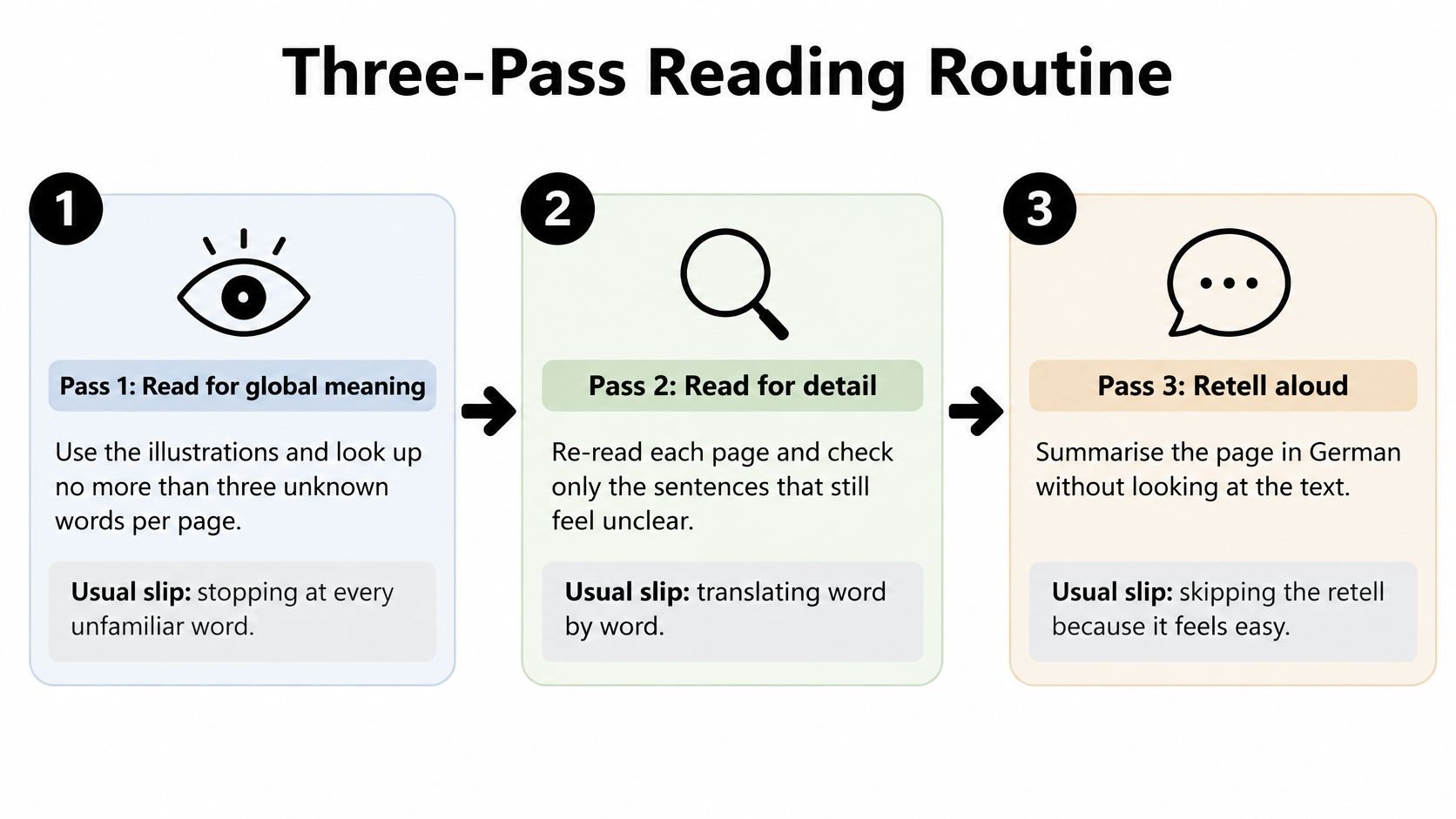
Give each pass a separate job
- Read for global meaning. Use the title and illustrations to identify the main event, looking up no more than three unknown words per page as a practical starting rule. The usual slip is translating every sentence and losing track of the story.
- Reread for patterns. Mark recurring verbs, useful phrases or a case ending that your teacher has introduced. The common mistake is highlighting so much that nothing stands out.
- Close the book and retell. Try three to five German sentences within five minutes, using simple language you can control. The usual slip is reopening the book immediately instead of attempting recall.
These are suggested working limits, not a test you must pass. If a short page still requires constant help, simplify the text rather than extending the session indefinitely.
Listen once after the first pass, then read without speaking aloud. During the second pass, check only the sentences that remain unclear instead of translating the entire passage again.
A study published in Reading and Writing involving 467 Hong Kong Chinese-English bilingual students found that morphological awareness influenced second-language reading comprehension directly and through vocabulary and word reading, with differences by grade. It examined English, so it doesn't establish a German-specific outcome, but it offers a useful reason to connect word recognition with meaning.
For German, that means noticing relationships without teaching an entire word family at once. At A1, connect ich gehe with er geht; add gegangen when past-time language is familiar, and introduce Spaziergang when the compound helps rather than distracts.
Include the texts you meet outside stories
Use notices, classified advertisements, posters and short messages alongside narrative chapters. Ask what action the reader should take, not just what individual words mean.
The Goethe-Zertifikat A1: Start Deutsch 1 examination description specifies a 25-minute reading component using short functional texts, including notes, classified advertisements, signposts and posters. A useful classroom task might ask which notice matches a person's needs and which detail rules out another choice.
For an additional study resource, use the video alongside active reading rather than as a replacement for it.
Suggested 45-minute teen A2 session
- Five minutes of vocabulary preparation: Revisit words needed for the chapter, including a noun with its article and a verb inside a useful phrase.
- Fifteen minutes of silent reading: Let the teenager read independently before discussing difficulties. Keep a note of unresolved sentences.
- Ten minutes of timed comprehension: Set eight questions covering main meaning, specific details, sequence and inference.
- Ten minutes of recorded retelling: Record a summary, listen back and choose a manageable correction target, such as verb position.
- Five minutes of planning: Set the next chapter and a short writing task, such as a message from one character to another.
This is a sample lesson allocation, not an official exam format. Correct misunderstanding before polishing every grammatical error.
Suggested 20-minute adult plan over five days
- Day 1, global reading: Complete the first pass and note the situation in plain language.
- Day 2, pattern reading: Complete the second pass and save useful phrases for appointments, travel or work.
- Day 3, audio practice: Spend five minutes shadowing a manageable passage, then use the remaining time for silent reading and checking.
- Day 4, spoken recall: Complete the third pass aloud without the text, then compare your account with the chapter.
- Day 5, comprehension check: Answer the questions, review mistakes and decide whether the next chapter is appropriately challenging.
If work disrupts the schedule, resume with the last passage rather than starting a new book. The German self-study plan with free resources can help organise reading alongside other language practice.
Suggested 15-minute parent-led plan four nights a week
For children aged 6 to 10, keep the interaction predictable and stop before tiredness turns reading into an argument.
- Track the picture: Point to the character or object as you read a short passage.
- Ask simple questions: Use Wer? Was? Wo? Accept pointing or a short phrase before expecting a complete sentence.
- Let the child participate: Invite them to repeat a recurring line, choose the matching picture or supply a familiar word.
- Record the effort: Use a sticker chart for completing the routine, not for perfect pronunciation.
Parents who aren't confident German speakers can use publisher audio for the model pronunciation. Their role is to organise attention and encouragement, not improvise grammar explanations.
Activities that work at home and in class
- Vocabulary cards: Put a useful phrase on the front and a meaning or picture on the back. Keep articles attached to nouns.
- Sequence drawings and dialogue: Draw the main events, arrange them in order, then act out a brief exchange between characters.
Progress check: Can you explain what happened without copying the page? That tells you more than a growing collection of highlighted words.
Allow several weeks of regular sessions for an initial A1 reader when it includes rereading, recall and related tasks. Treat that as a planning allowance, not a deadline: book length, prior learning and the amount of support all affect the pace.
How Much Can CEF Cover for a German Course?
According to the Continuing Education Fund's German-language guidance, eligible adults aged 18 or above can claim reimbursement for CEF-reimbursable courses up to HK$25,000, applying within one year after successful course completion. The scheme is non-means-tested, but language-course applicants must pass the designated benchmark test or examination at the required level where applicable.
The CEF reimbursement procedures set the learner's share at 20% of the course fee for the first HK$10,000 of subsidy and 40% for the remaining HK$15,000 of subsidy.
CEF co-payment by subsidy tranche
| Subsidy tranche | Learner pays | Maximum subsidy |
|---|---|---|
| First subsidy tranche | 20% of course fee | HK$10,000 |
| Remaining subsidy tranche | 40% of course fee | HK$15,000 |
| Total entitlement | The applicable share in each tranche | Combined maximum stated above, subject to eligibility and the application deadline |
The reimbursement procedures define eligible course fees as tuition and, where applicable, examination fees for designated language benchmark tests. Late charges and course-change fees aren't reimbursable, so advertised tuition and the amount eligible for reimbursement may differ.
Check the complete budget before enrolling
- List tuition separately. Ask for the fee for the exact course and intake you intend to join.
- Add the designated examination fee. Confirm whether it is included and whether it qualifies for reimbursement.
- Separate incidental charges. Keep late-payment, rescheduling, course-change and book costs outside your assumed reimbursement unless eligibility is confirmed.
- Verify current course status. Ask the provider to confirm CEF eligibility before enrolling, and retain receipts and completion documents.
Don't assume that a German course qualifies merely because it prepares learners for an examination. Compare the eligible total, your required contribution and the assessment conditions using the guide to CEF-funded German courses in HK.
CEF funding is a course-budget question, not a reason to buy a particular graded-reader series.
Ready to Start Learning and Find Your Reading Level
A reader that feels manageable at your current CEFR stage can build confidence, while a text packed with unfamiliar words can slow your progress. Before buying a series, check its level and format, compare the cost, and confirm whether your chosen course is eligible for CEF funding. Then match the book to your next goal, such as Goethe-Zertifikat preparation, school exams, or German for work or travel.
Choose support that connects with your goal
The German Cultural Association Hong Kong(GCA) offers in-person classes near Tsim Sha Tsui and Causeway Bay MTR stations, as well as interactive Zoom sessions. Its native German-speaking faculty teaches in small groups of up to six students and in private one-on-one sessions. GCA also offers Goethe-Zertifikat preparation, alongside IGCSE, A-level and IB exam preparation, and Business German and Travel German courses.
Reading practice can support these goals, but it does not replace speaking practice or exam preparation. If you are unsure which course or reader suits your level, contact GCA through its website to discuss your goals. For extra practice, browse German resources from MasteryMind and choose material that fits your stage, rather than overloading your weekly study time.
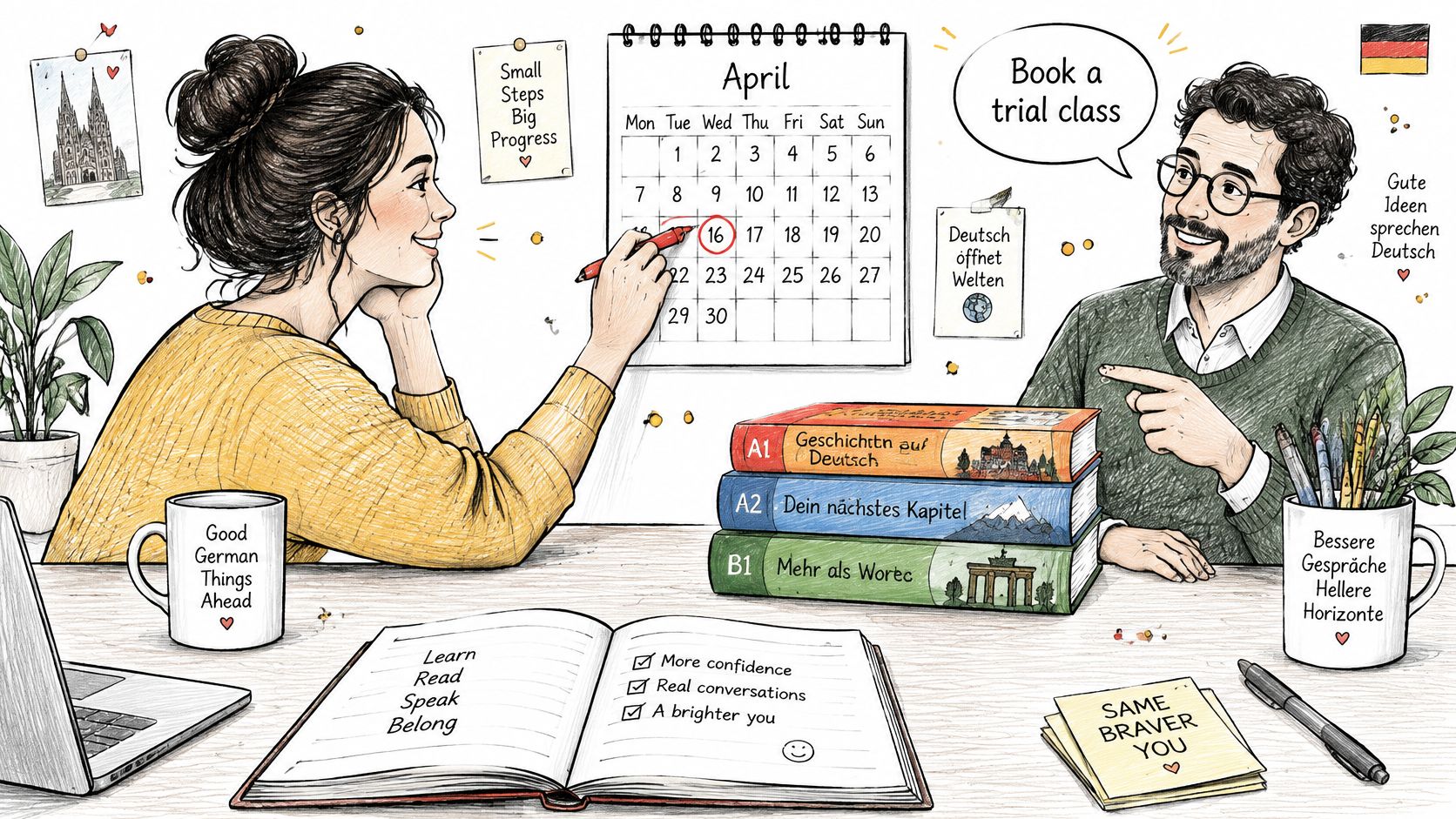
Use this checklist before you commit:
- Set your target: Identify your CEFR stage and whether you are working towards an exam, school requirement, or career goal.
- Check course eligibility: Ask whether the course you have in mind qualifies for CEF funding.
- Compare schedule and format: Check the latest class options against the time you can realistically study.
- Choose your reader: Select a series that matches your level and budget, then build regular reading into your routine.
Visit German Cultural Association Hong Kong(GCA) to discuss your level and goals, and explore its class options before purchasing a graded reader.
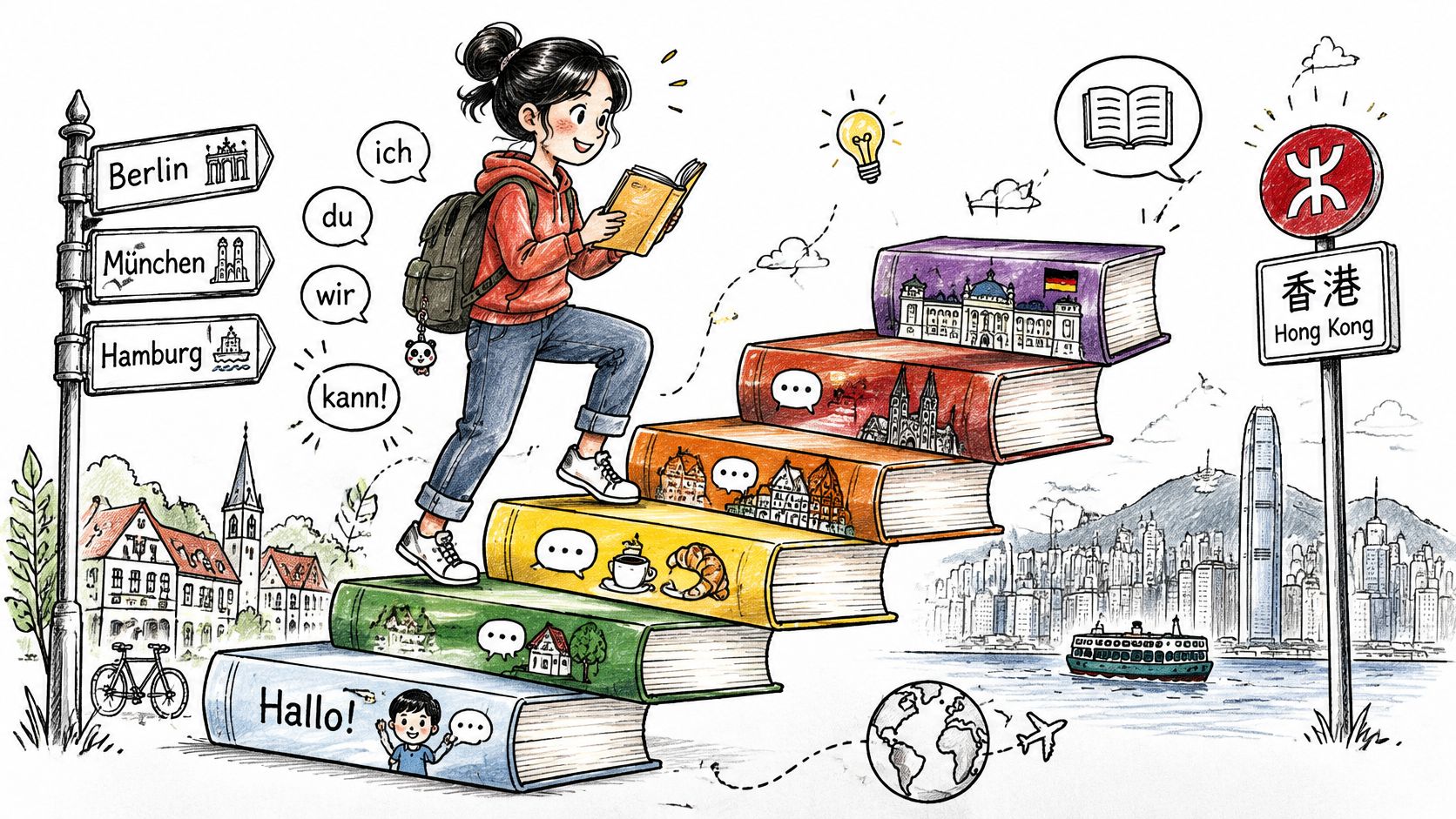
German Reading for Beginners: Graded Readers by CEFR Level

Costs and Language Requirements for German in HK


