.png)
.png)

BLOG

香港德國文化協會
The German Cultural Association
German Tutor Hong Kong 2026: Rates
German Tutor Hong Kong 2026: Rates start at HK$400 to HK$800+ per hour for private lessons, and small-group classes usually land around HK$150 to HK$400 per learner per hour. That gap is the point, German is priced in Hong Kong as a specialist subject, not a mass-market language class.
If you're comparing tutors right now, you're probably trying to answer a practical question. How much should you really budget for a German lesson in HK, and which format gives you the best value for an exam, a visa plan, a study-abroad goal, or a career move?
Table of Contents
- Credentials and native-speaker delivery
- Exam specialization
- Location and overhead
- Materials and curriculum access
- Class size in group formats
- A primary-school child
- A teenager targeting IGCSE and IB
- A working professional preparing for B1 or Business German
What 2026 German Tutoring Costs in Hong Kong
The first thing to price is the lesson type, not just the hourly headline. In Hong Kong, a private German tutor commonly sits at HK$400 to HK$800+ per hour, while small-group German classes are often estimated at HK$150 to HK$400 per learner per hour (Hong Kong private German lessons rate guide).
What the headline rate hides
The total bill is usually bigger than the quote. Trial lessons, make-up classes, materials, and rescheduling rules change the total cost, and those items matter more in Hong Kong than people admit. Two tutors can both advertise a similar hourly price, but one may bundle materials and flexible make-up lessons while the other charges extra every time you miss a class.
Practical rule: Don't compare German tutors by hourly rate alone. Compare the full lesson policy, then divide the total by the number of usable teaching hours.
A local German course page also benchmarks a standard group course at HK$2,500 to HK$3,750 for about a 10-week course, while private tutoring starts at around HK$450 per hour. That reinforces the core point. German in Hong Kong behaves like a specialist academic service, not a casual after-school language class.
If you're planning spending, price these formats first:
- One-to-one private lessons if you need speed, oral correction, or a fixed exam deadline.
- Small-group lessons if you want a lower per-learner cost and more structure.
- Mixed private plus group if you want targeted correction without paying for every single hour privately.
A quick way to organise comparisons is to write down the lesson format, teaching hours, material fees, and cancellation policy in one sheet. That gives you the actual cost before you commit.
For families or schools that need to turn a rate list into a simple comparison sheet, the ShortGenius AI ad generator can be used as a basic drafting tool. It is not a tutor selector, and it should not replace a proper quote, but it can help you lay out options cleanly when you are comparing providers fast.
By the end of this first pass, your budget should already tell you something useful. If a quote sits far below the specialist range, ask what is missing. If it sits far above it, ask what outcome you are paying for.
Why German Sits in HK's Premium Tutoring Tier
Hong Kong's tutoring market has always priced specialist subjects above ordinary school help, and German belongs in that premium band. Independent 2026 tutoring guides report one-on-one sessions can cost HK$150 to HK$600 per hour depending on tutor type, while IB/IGCSE specialists often price at HK$500 to HK$800 for mid-experience tutors and HK$1,400 to HK$2,500 for top-school or high-scoring tutors (Hong Kong tutoring cost guide).
What that means for German buyers
German is not priced like basic homework support because the buyer usually wants one of three things. They want exam results, study abroad access, or career-ready speaking. That is why German sits closer to international-curriculum tutoring than to standard school catch-up lessons.
Hong Kong's wider tuition market confirms that pattern. Experienced private tutors may charge HK$500 to HK$1,200 per hour, and monthly private tutoring budgets can reach HK$6,000 to HK$9,600 for secondary students (Hong Kong tutoring fee guide). German is competing in that same premium zone, especially when parents compare it with DSE, IB, or IGCSE support.
German pricing in HK tracks outcome pressure, not just language difficulty.
Why location and delivery matter
Premium areas, such as Causeway Bay and Tsim Sha Tsui, naturally support higher overhead. Smaller rooms, specialist teachers, and tighter scheduling all add cost. That's also why native-led German instruction with small classes is priced above generic tutorial centre lessons, because families are paying for more than contact time.
For HK learners, the bigger question is not whether German is expensive. It's whether the spending is aligned with the right path, CEF-eligible study, exam prep, or a faster route to a German-speaking university.

Side-by-Side Rate Comparison by Format
The cleanest way to compare German tutoring in Hong Kong is by format, not by brand name. The same language can cost very differently depending on whether you want private attention, a shared class, or a structured school-style course. The published GCA course listings are useful here because they show actual lesson structure and pricing rather than vague marketing language (GCA course listings).
| Format | Class size | Hourly rate (HK$) | Typical package | Best for |
|---|---|---|---|---|
| Private one-to-one | 1 student | HK$400 to HK$800+ | Hourly booking, sometimes higher for specialist exam prep | Fast exam pivots, oral drills, personalised correction |
| Small-group class | 3 to 6 students | HK$150 to HK$400 per learner | Example group course at HK$4,180 for 11 lessons of 2 hours over 11 weeks | Retention, cost control, steady progress |
| Children's group course | Small group | Not framed as hourly on the listing | HK$1,100 for 4 lessons of 1 hour | Younger learners who need short, structured sessions |
| Teen class | Small group | Not framed as hourly on the listing | HK$1,650 for 6 lessons of 2 hours | Teens preparing for school German and exam foundations |
| Online or hybrid learning | Varies | Usually mirrors the format pricing above | Depends on schedule and package | Flexibility, commuting relief, adults with irregular hours |
The local rate comparison at private German lessons in Hong Kong shows the premium gap clearly. One-to-one lessons suit learners who need immediate error correction. Small groups are better when you want a lower total spend and enough speaking time to keep momentum.
For corporate learners, the logic is different. Companies usually pay for consistency, delivery convenience, and language used in meetings or relocation support. Online is the fallback when commuting kills attendance, but it works best when the curriculum is already tight.
What Drives a Tutor's Quote Up or Down
A German quote in Hong Kong doesn't move randomly. It rises or falls for a small set of reasons, and buyers should interrogate each one before they pay. If you know the drivers, you can tell whether you're buying real expertise or just a polished profile.
Credentials and native-speaker delivery
Native-speaker teachers and advanced credentials push rates up because they usually bring better pronunciation standards, stronger cultural correction, and more precise language modelling. That matters most when the learner is preparing for Goethe-Zertifikat, TestDaF, IGCSE, A-level, or IB. If a tutor's price is high, ask what teaching qualification or exam-prep experience sits behind it.
Exam specialization
A tutor who knows general conversation is not the same as a tutor who knows exam marking logic. Goethe-Zertifikat, school exam writing, oral practice, and university-entry German each require different lesson design. That is why exam-prep quotes usually sit above casual speaking support. Ask which exam papers the tutor has prepared students for, not just which exams they know by name.
Location and overhead
A lesson in a central Hong Kong location often costs more because of rent, travel time, and scheduling convenience. Outlying or less central arrangements can be cheaper, but they often cost you more in travel friction. Ask whether the quote includes centre access, online flexibility, or rescheduling support.
Materials and curriculum access
Some tutors hand you worksheets and improvise. Others use a structured curriculum with set progression, which is usually better for exam learners. If you're paying a premium, ask whether the package includes materials, writing feedback, and a progress plan. A higher quote with a real curriculum can be cheaper than a lower quote that wastes time.
Class size in group formats
Group pricing should reflect the number of students, not just the room size. GCA's public listings show a 3 to 6 student adult format, which is exactly the kind of size that lets a learner speak often enough to matter (GCA course listings). If a class is cheap but overcrowded, your speaking time is probably the first thing sacrificed.
Exam Preparation Premiums and Target-Level Pricing
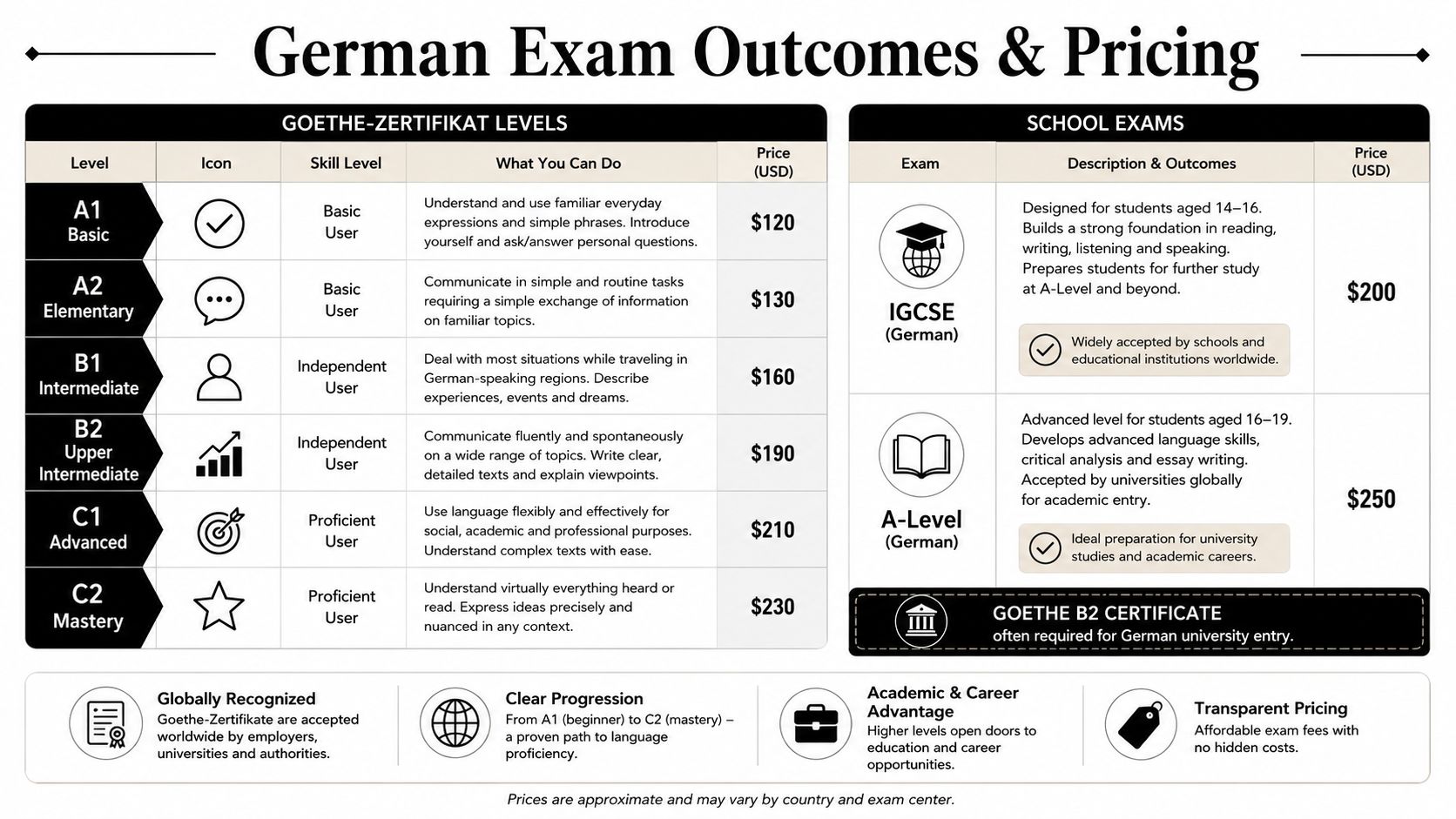
German exam prep in Hong Kong should be priced by target outcome, not by vague confidence. A learner going for Goethe-Zertifikat A1 does not need the same budget as someone targeting B2, TestDaF, or school German for IGCSE and A-level. That's why serious families and professionals should price the level first, then choose the teaching format.
The German proficiency test registration and fees in HK page is useful because it reminds learners that certification is the goal, not endless attendance. A Goethe B2 certificate is often expected for German university entry, so a cheaper lesson that doesn't move the learner toward that certificate is poor value.
How target level changes the budget
A beginner who wants a clean pass at B1 will usually need far more guided teaching than someone polishing a specific school essay format. For IB German, the price pressure comes from sustained practice, writing correction, and oral simulation, not from casual conversation. For IGCSE and A-level, the premium is in exam alignment and marking-style feedback.
Budget rule: the more exact the exam target, the less useful random hourly tutoring becomes.
If you're also comparing language pathways for other subjects, even a different exam framework, such as the SAT study tools auf Deutsch, can help you think clearly about study structure. The lesson is the same. A target-level plan usually beats unstructured practice.
For HK learners, the premium is not just the teacher. It's the teacher plus the exam map.
Realistic Monthly and Course Budgets for HK Learners
Raw hourly rates don't help much until you turn them into a monthly plan. Hong Kong parents and professionals want to know the actual cash commitment, not a theoretical lesson price. So here's how I'd model three common cases based on the rate bands and local course structures already discussed.
A primary-school child
For a child who needs steady support, one private hour a week plus a small-group supplement is usually enough to build confidence without overpaying. If you use one private lesson at the specialist band and add a group class, you're buying correction and repetition. That's a sensible mix for younger learners who don't need heavy exam pressure yet.
A family in this category should budget for a monthly total that sits around the low-to-mid specialist range, depending on whether the group supplement is monthly or term-based. For a course total, a children's listing at HK$1,100 for 4 lessons of 1 hour gives you a concrete local benchmark (GCA course listings).
A teenager targeting IGCSE and IB
The bill climbs because teens need exam language, writing correction, and oral preparation. Two private hours plus one group class, plus a targeted exam-prep block, is a realistic structure. This is also the point where families should stop buying “general German” and start buying exam outcomes.
For a teen in a school-exam pathway, the course budget should be modelled against the published teen class at HK$1,650 for 6 lessons of 2 hours (GCA course listings). That number helps parents anchor expectations before adding any private support.
A working professional preparing for B1 or Business German
Adults usually need fewer classes than teens, but the pressure is higher. One group class plus monthly private correction is often the most efficient setup because it balances cost, accountability, and speaking practice. If the goal is business use or a certification milestone, pay for structure, not just conversation.
The strongest budgeting move for adults is to combine a group course with a few private sessions only when needed. That reduces waste and keeps the monthly spend more predictable. If you want a funding angle, the complete guide to CEF funded German courses in HK is worth checking before you commit.
Booking, Negotiation and Trial-Class Tips for HK Buyers
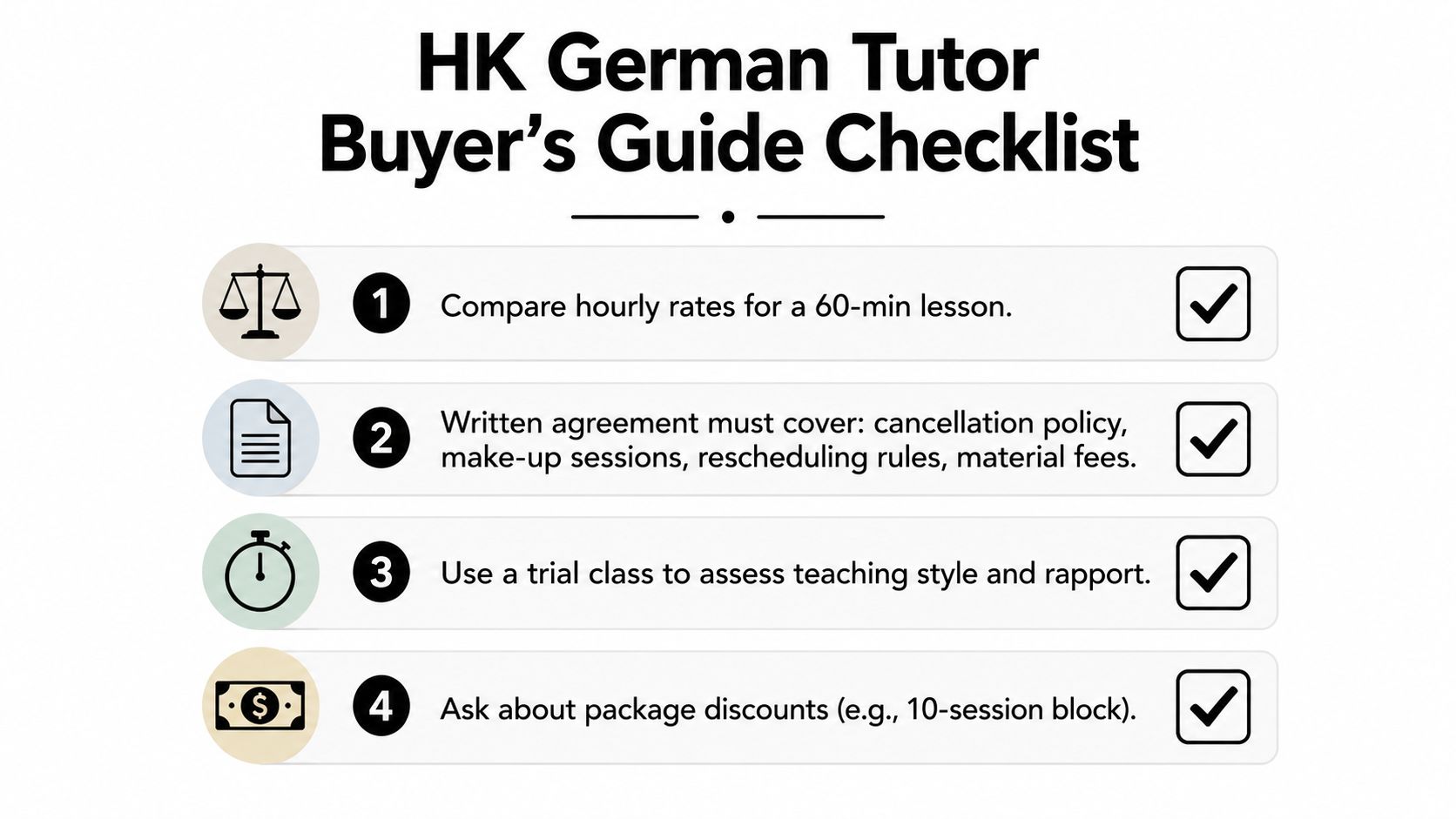
A good German buyer in Hong Kong asks the right questions before paying. A bad buyer compares only the hourly figure and then discovers hidden friction after the first month. If you want a fair quote, compare two tutors on the same basis, same lesson length, same materials, same cancellation terms, same rescheduling rights.
What should be in writing
You should always ask for a written agreement that covers:
- Cancellation policy: how much notice you need to avoid losing the lesson.
- Make-up sessions: whether missed classes can be replaced.
- Rescheduling rules: whether online swaps are allowed.
- Material fees: whether books, handouts, or worksheets cost extra.
That last point matters more than people think. A cheap quote with strict penalties can become the most expensive option in the room.
How to use a trial class properly
A trial class is not about being impressed. It's about checking whether the tutor corrects errors clearly, speaks at the right pace, and understands your exam or career target. If the lesson feels vague, it will probably stay vague. If the tutor can't explain the next three weeks of learning, keep looking.
For contract handling, many tutors and schools now prefer digital sign-off. A practical tool for that is streamline tutor agreements with eSignature, especially when families want a clean record of the policy before they pay.
What to ask in your next enquiry email
- Is the quote for 60 minutes or a shorter teaching block?
- Are materials included or billed separately?
- Can I switch between online and in-person lessons?
- Do you offer a package rate for 10 sessions or a similar block?
If the answers are vague, the deal is probably weaker than it looks. In Hong Kong, the cheapest hourly quote is often the least flexible, and flexibility matters when you're paying for results.
Choosing a Structured, Native-Led Program Over Ad-Hoc Tutoring
If the goal is an exam result, a university application, or workplace German, ad-hoc tutoring usually wastes time. A structured program with native speakers and a set curriculum keeps the learner moving forward instead of re-inventing the plan every week. That matters especially for serious goals like Goethe-Zertifikat, TestDaF, IGCSE, A-level, and IB.
A native-led small-group model is also easier to justify on cost-per-outcome. You get repeated exposure, clearer pacing, and a syllabus that already knows where the learner should land. GCA's public positioning is built around that structure, with 3 to 6 student classes, plus private lessons and course streams for kids, teens, adults, and exam preparation (GCA course listings).
The strongest case for a structured path is simple. When the timetable is fixed and the teacher is used to official exams, learners stop paying for drift. They pay for progression.
The model also fits Hong Kong life better than many people admit. Causeway Bay, Tsim Sha Tsui, and online delivery give working adults and parents enough flexibility to stay consistent without turning German into a scheduling headache.
If you want a structured German path in Hong Kong, GCA offers native-led classes, small-group teaching, private lessons, and exam-focused support for Goethe-Zertifikat, TestDaF, IGCSE, A-level, and IB. Visit German Cultural Association Hong Kong(GCA) to check the current schedule, book a trial class, and compare the right format before you pay for the wrong one.

German Reading for Beginners: Graded Readers by CEFR Level

Costs and Language Requirements for German in HK


