


BLOG

香港德國文化協會
The German Cultural Association
German for Finance in Hong Kong: Levels, Exams and Costs
A Hong Kong credit analyst receives a risk memo from a German parent company and needs to respond before the next reporting deadline. Knowing general German won't be enough: the analyst must read the financial terms accurately, explain the figures and choose a professional tone.
Table of Contents
What Is German for Finance?
German for Finance is German taught through the terms, documents and conversations of banking, asset management, insurance and corporate finance. Learners practise complete sentences using language found in bank papers, credit files and annual reports, so they can interpret information and communicate clearly in real finance situations.
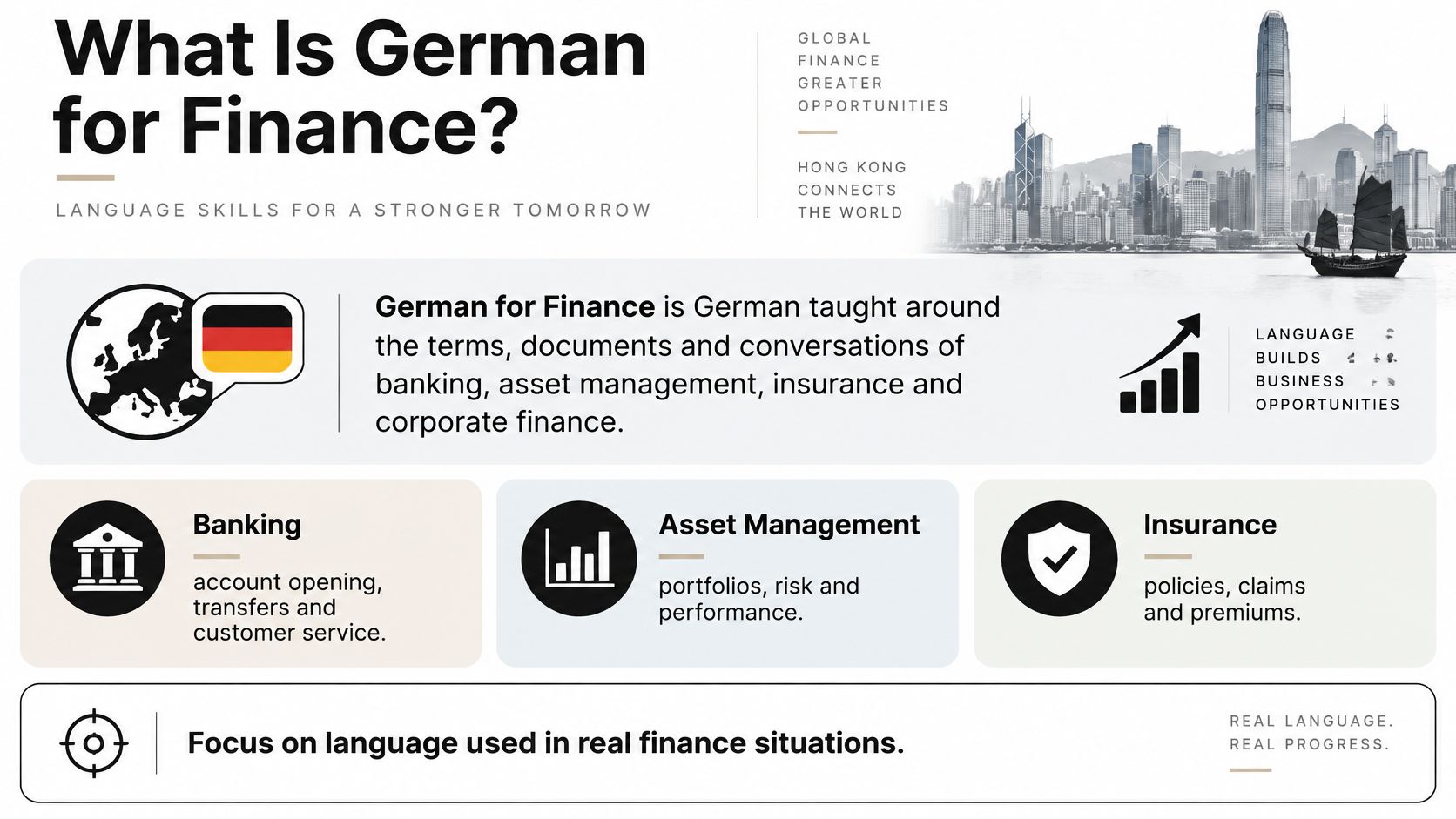
In that memo scenario, the analyst needs to understand what the German team means by Kreditrisiko (credit risk), identify the reporting period, and reply without blurring a concern with a confirmed finding. That practical focus is what separates German for Finance from a general conversation course or broad Business German syllabus.
Hong Kong has a substantial finance workforce and a strong economic base for this specialisation. The Hong Kong Yearbook reports that financial services employed approximately 265,000 people and contributed 26.2% of Hong Kong's economy. Separately, the Census and Statistics Department recorded approximately 43,400 people engaged in financial-markets and asset-management services in 2024. Those activities generated HK$78.3 billion in value added in 2023, or 2.7% of GDP.
German business activity in Hong Kong is also connected to regional operations. In the 2025 joint Business Confidence Survey, 30.4% of surveyed German businesses with parent companies outside Hong Kong operated as regional headquarters, while 21.7% were regional offices, according to the German Chamber of Commerce and Delegation of German Industry and Commerce survey. That structure can put Hong Kong teams in regular contact with German-speaking parent companies and colleagues across the region.
Who benefits from specialised German?
- Banking and finance staff working with German-headquartered institutions, including Deutsche Bank Aktiengesellschaft and DZ Bank AG Deutsche Zentral-Genossenschaftsbank.
- Regional headquarters teams reporting budgets, risk and performance to German parent companies.
- Students preparing for German-speaking university programmes or planning to study abroad in Germany.
- Families and professionals considering future work or relocation in Germany.
The skill set has three connected layers: finance vocabulary, document reading and high-stakes conversation. A useful first self-test is simple: can you explain a financial ratio in complete German sentences, including what it measures and which benchmark applies?
For a career application, pair language study with evidence of relevant work. This guide on how to show recruiters proof of your impact can help you connect a finance achievement to a clear, results-focused application. To place German study in a realistic progression, see this guide to German CEFR levels for Hong Kong learners.
Finance Terminology and Grammar to Master
A credit memo can hinge on one distinction: Kernkapitalquote means the Tier 1 capital ratio, while harte Kernkapitalquote means the Common Equity Tier 1 (CET1) ratio. Learning each term in the document where it appears helps you recognise what a figure measures before discussing it with colleagues or a German-speaking regional headquarters.
Hong Kong's banking system includes German-headquartered institutions, making finance vocabulary relevant to regional work. The Hong Kong Monetary Authority's banking-sector review reports an average category-1 liquidity coverage ratio of 171.2% in Q3 2025, against a statutory minimum of 100%. It also reports a 24.4% total capital ratio for locally incorporated authorised institutions, compared with an international minimum of 8%.
To explain a ratio clearly, name the measure, reporting period and benchmark. For example: Die Liquiditätsdeckungsquote der Bank lag im dritten Quartal 2025 bei 171,2 Prozent und damit über der gesetzlichen Mindestanforderung von 100 Prozent. This sentence makes the comparison explicit, a useful habit in a finance discussion or written update.
Core German finance terms and where they appear
| German term | English meaning | Where you meet it |
|---|---|---|
| Kreditrisiko | Credit risk | Credit committee papers |
| Liquiditätsdeckungsquote | Liquidity coverage ratio | Treasury and regulatory reports |
| Kernkapitalquote | Tier 1 capital ratio | Capital adequacy reporting |
| harte Kernkapitalquote | Common Equity Tier 1 (CET1) ratio | Capital adequacy reporting |
| Sicherheiten | Collateral | Credit memos and loan files |
| Außenhandelsfinanzierung | Trade finance | Exporter and bank discussions |
| Jahresabschluss | Annual financial statements | Audit and reporting packs |
| Geschäftsbericht | Annual report | Investor relations |
| Konzernabschluss | Consolidated accounts | Group reporting |
| Forderungen | Receivables | Balance sheets |
| Verbindlichkeiten | Liabilities | Balance sheets |
| Eventualverbindlichkeiten | Contingent liabilities | Risk disclosures |
| zwischenbetriebliche Finanzierung | Intercompany financing | Group treasury |
| Außenstände | Outstanding receivables | Collections and credit control |
Two terms can sound similar in group treasury discussions but refer to different things. Zwischenbetriebliche Finanzierung is financing between companies within a group. Außenstände are amounts customers or other parties still owe.
Grammar shapes how financial information is presented. German reports often compress a clause into a noun phrase: Die Verschuldung ist gestiegen (“Debt has increased”) becomes der Anstieg der Verschuldung (“the increase in debt”). The genitive links entities and documents, as in der Geschäftsbericht der Bank (“the bank's annual report”).
In clauses introduced by weil and dass, the conjugated verb usually moves to the end. In Die Bank prüft den Kredit, weil sich das Risiko erhöht hat, the verb phrase closes the weil clause. Formal reports also use passive constructions: Die Quote wird berechnet means “The ratio is calculated.”
Practise by reading a paragraph from a German annual report and drafting a short English credit memo. Record the reporting entity, period, currency, exposure and any stated collateral before summarising the conclusion. To connect that analysis with role expectations, consult this overview of what organisations seek when they Hire Financial Analysts.
Which Exam Fits Your Goal in Hong Kong?
Start with the institution, employer or school that will assess your German. Find out which examination it accepts, then work backwards to the level and preparation you need. A certificate can support an application, but it doesn't automatically satisfy every university's, employer's or authority's requirements.
| Exam | Who sits it | Approximate level | Main use |
|---|---|---|---|
| Goethe-Zertifikat B2 | Professionals and university applicants | B2 | Recognition by many German employers and universities |
| Goethe-Zertifikat B2 Wirtschaftsdeutsch | Finance and business professionals | B2 | Business-context German for work |
| Goethe-Zertifikat C1 | Academic and senior professional candidates | C1 | Advanced academic and leadership roles |
| TestDaF | Applicants to German-speaking universities | B2 to C1, TDN 3 to TDN 5 | Admission requirement at many universities |
| IGCSE German | Secondary students on IGCSE curricula | About A2 to B1 | Secondary qualification |
| A-level German | Students on A-level pathways | About B1 to B2 | University entry in the UK and beyond |
| IB Ab initio | Diploma Programme beginners | About A1 to A2 | IB Diploma subject |
| IB Deutsch B | Diploma Programme students with prior German | About B1 to B2 | IB Diploma subject |
For professional communication, Goethe-Zertifikat B2 can be a useful target, while B2 Wirtschaftsdeutsch focuses more directly on workplace contexts. Candidates preparing for advanced academic study or senior responsibilities may consider C1, but the level alone doesn't guarantee acceptance.
Many German universities ask applicants to take TestDaF. It tests four skills, and each is graded from TDN 3 to TDN 5; TDN 4 is a common target. Requirements differ by institution and programme, so check the stated score and skill-by-skill conditions before choosing a course.
For students following UK-based curricula, IGCSE German and A-level German are relevant school qualifications. Within the IB Diploma Programme, Ab initio is designed for beginners, while Deutsch B suits students with more German experience. If you're comparing certificate routes, this guide to Goethe-Zertifikat and TestDaF can help you frame the choice.
Two cautions matter. A German certificate does not replace a visa application, and each institution sets its own score and certificate-validity rules. Confirm the exact requirement with the school, university, employer or authority before you enrol.
How Long Business German Takes and How to Plan It
A Hong Kong finance professional may need German for a short client call, a credit discussion with regional headquarters, or a written risk update. Each task calls for a different level of control, so estimate the learning time from your starting point, target and available study hours. Progress takes sustained practice, with lessons, independent study, speaking and feedback working together.
The ranges below are general planning estimates, not guaranteed completion dates. They refer to total guided and independent study. A teacher's assessment can help you set a more realistic pace for your current level and goal.
| Learner goal | Target level | Typical study estimate |
|---|---|---|
| Working professional starting from zero | B1 | About 350–600 study hours, often 18–30 months at 5–6 hours per week |
| Working professional with German-speaking clients | B2 | About 500–800 study hours from beginner level, often 24–40 months at 5–6 hours per week |
| University applicant on the TestDaF or C1 route | C1 | About 700–1,000 study hours from beginner level, often 32–50 months at 5–6 hours per week |
| Visa applicant, family or work route | A1 to B1, depending on route | About 100–600 study hours from beginner level, depending on the required level |
| Secondary student, IGCSE or A-level route | A2 to B2 | About 180–800 study hours from beginner level, depending on the target |
| Adult travelling to German-speaking countries | A2 | About 180–200 study hours from beginner level |
These estimates describe broad learning ranges. Prior study, lesson frequency and time spent practising between classes all affect the calendar. A learner who already understands everyday German may need fewer hours than someone starting from zero.
For finance work, build general grammar and speaking ability alongside job-specific language. Practise explaining a balance-sheet item or clarifying a payment condition in a complete sentence, rather than memorising isolated terms. That is how vocabulary becomes usable in a meeting or email.
Three habits support steady progress:
- Keep one fixed lesson slot. A regular appointment helps maintain a learning rhythm around work or school.
- Review finance vocabulary in short sessions. Use terms from the documents you are studying and practise them in complete sentences.
- Write one German finance email each week and get feedback. Ask a teacher to mark clarity, grammar and register, not just spelling.
Irregular attendance makes it harder to build on previous material. Without speaking practice, learners may know a term but struggle to use it in a call. Specialist vocabulary is also difficult to apply before you can form basic German sentences.
Build a weekly routine you can keep
- Choose the exam and target first. Use the requirement set by the institution. A professional may focus on Goethe-Zertifikat B2, while a university applicant may need to prepare for TestDaF or a C1 qualification.
- Work backwards from your deadline. Decide how many study sessions fit your work or school week, then discuss the schedule with a teacher. If the target date is close, identify which skills need the most attention before booking an exam.
- Pick a format that supports your goal. Small groups provide opportunities to speak with other learners. Private lessons allow more time for specific exam techniques or work documents. Zoom may make regular lessons easier to schedule.
- Fix your lesson times. Keep the same weekday and time where possible, and decide how you will make up a missed session.
- Add independent practice and review. Schedule two short study sessions each week. Use a mock test or teacher feedback to check whether reading, writing, listening and speaking are developing together.
Spread practice across the week instead of relying on one long session. Repeated encounters with terms and sentence patterns help you recall them in different situations. Keep a record of recurring errors, such as word order after weil, article endings or the difference between a liability and a contingent liability, then review those points deliberately.
What a Finance German Course Covers Week by Week
A useful finance course takes learners from reading documents to explaining their meaning to another person. The sample sequence below starts with the balance sheet, moves through credit and risk language, and ends with a careful explanation of product status and regulatory uncertainty.
| Week block | Lesson topic | Outcome |
|---|---|---|
| Weeks 1-2 | Reading a German balance sheet | Name assets, liabilities and equity correctly |
| Weeks 3-4 | Credit memo language | Describe collateral, exposure and maturity in full sentences |
| Weeks 5-6 | Explaining ratios such as the LCR and CET1 | Explain a ratio against its regulatory minimum |
| Weeks 7-8 | Presenting to German headquarters | Deliver a concise risk update |
| Weeks 9-10 | Negotiating payment terms | Clarify due dates, payment conditions and points of disagreement politely |
| Weeks 11-12 | Regulatory and fintech vocabulary | Explain product status without overstating approval |
During the opening block, learners identify Forderungen and Verbindlichkeiten in a balance sheet, then practise explaining what each item represents. The next exercises put Sicherheiten, exposure and maturity into credit memo sentences, so the learner can distinguish a fact in the file from an interpretation.
The ratio block develops a precise way to state what a figure measures and how it compares with the relevant benchmark. Later, learners rehearse a short update for a German headquarters team and negotiate payment terms with language that remains clear and courteous, even when they need to disagree.
The final block covers Genehmigung (approval), aufsichtsrechtliche Anforderungen (regulatory requirements), Risikohinweis (risk warning) and Markttest (market test). The aim is to describe a product's status accurately, without presenting a market test or pending review as regulatory approval. Hong Kong's focus on fintech makes this kind of careful explanation relevant: the Hong Kong business and market overview reports that the city's IPO market raised more than HK$280 billion in 2025.
Assessment and teaching
Each block can end with a role-play scored on term accuracy, sentence structure and politeness register. A strong response does more than translate a word correctly. It names the relevant document or figure, gives the listener enough context, and avoids claiming more certainty than the source supports.
GCA's teaching team includes native German speakers and teachers with advanced degrees in German education. Rebecca holds a Goethe-Institut certification in teaching German as a Foreign Language, which supports the connection between clear instruction and exam-focused preparation.
How Much Can CEF Funding Cover in Hong Kong?
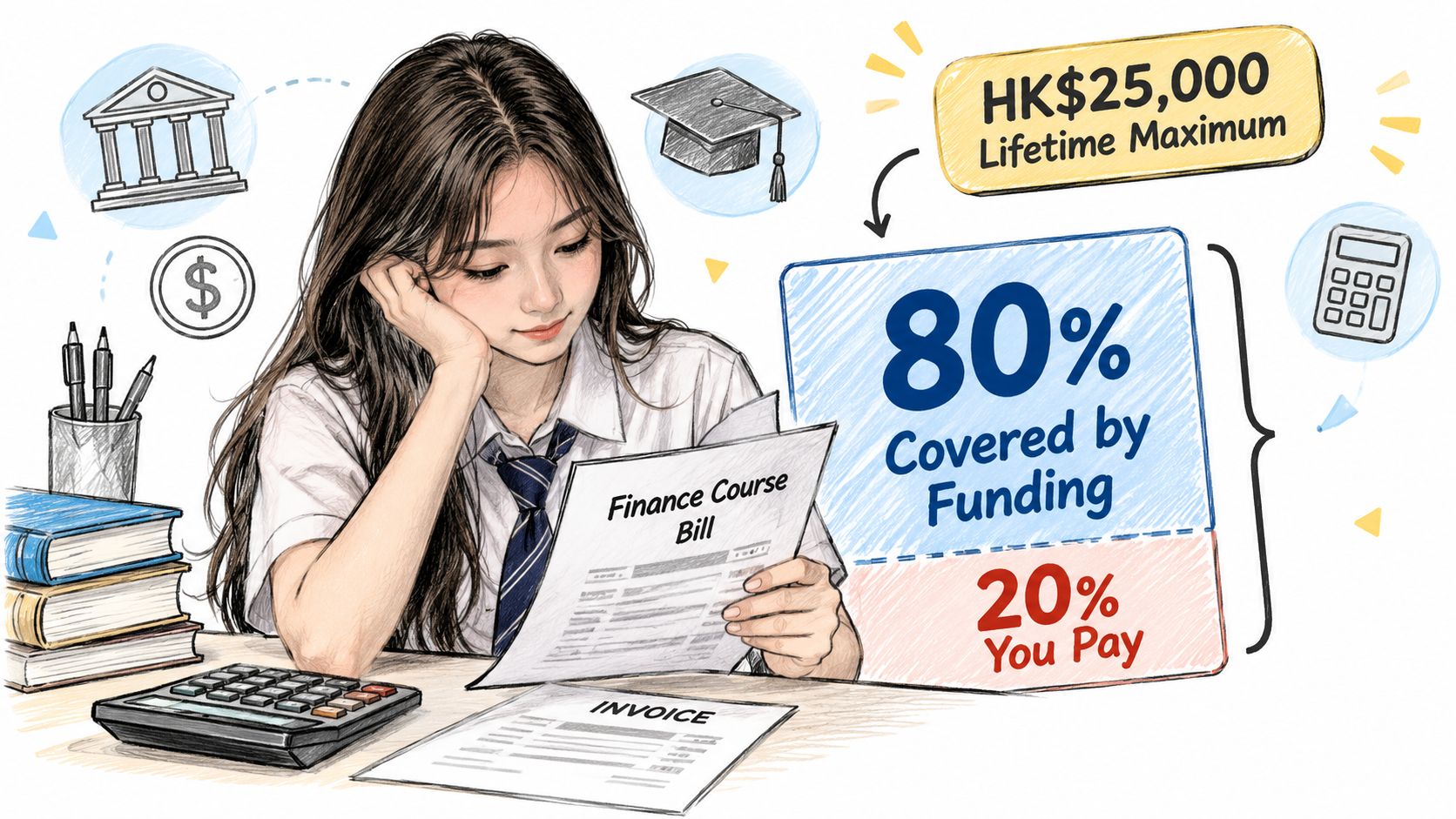
The Continuing Education Fund (CEF) can reimburse eligible courses up to a lifetime maximum of HK$25,000, but it doesn't pay the entire course fee automatically. Your budget should account for the required co-payment and the course's eligibility; the CEF expenses guidance sets out the lifetime maximum and claim deadline.
Under the two-tier structure, the learner's share is 20% of the course fee for the first HK$10,000 of subsidy entitlement and 40% for the remaining HK$15,000. That means you should calculate the likely reimbursement using the actual eligible course fee, rather than treating the maximum as a guaranteed payment.
Illustrative calculation: If an eligible course costs HK$10,000, the learner's 20% share is HK$2,000, leaving HK$8,000 as the potential reimbursement, subject to the scheme's requirements. Replace the illustrative fee with the published fee for the course you're considering.
Check eligibility before enrolling
- Residency and age: Applicants must meet the CEF residency rules and be at least 18 when the course begins. Qualifying residents include people whose Hong Kong Identity Card records the right of abode, right to land or unrestricted stay, as well as holders of a Mainland Permit for Proceeding to Hong Kong and Macao. A parent shouldn't assume that a child under 18 can personally claim support.
- Attendance and assessment: The learner generally needs to attend at least 70% of contactable hours, or meet a higher threshold set by the course, and achieve an overall assessment mark of at least 50%, unless the course requires more. A language course may also require a designated benchmark test or examination. The CEF post-course procedures explain these completion standards.
- Application timing: Submit the reimbursement claim within one year after successful course completion. Add the deadline to your calendar as soon as the course ends.
The CEF eligibility guidance explains who can apply. Before enrolling, confirm the course-specific attendance and assessment rules with an advisor, then keep your attendance and completion records together. For more detail on the process, consult this guide to CEF-funded German courses in Hong Kong.
Ready to Start Learning?
- Book a trial class. A qualified German teacher assesses the trial lesson, so you can begin at a level that suits your current ability.
- Contact an advisor. WhatsApp +852 6905 6491 or email contact@german.com.hk to discuss your exam route, CEF eligibility and preferred format.
- Check the latest course schedule. Compare small-group, one-to-one and Zoom options, and choose a format you can maintain alongside work or school.
Our adult courses include Business German and TestDaF exam preparation, alongside Goethe-Zertifikat preparation. GCA offers native German-speaking teachers, a structured curriculum, small groups of up to six students, easy online rescheduling, and in-person centres near Tsim Sha Tsui and Causeway Bay MTR stations.
Send your target exam and deadline to an advisor, and they'll map the study weeks back from it.
German Cultural Association Hong Kong(GCA)offers structured Business German and exam preparation with native German-speaking teachers, including practice for finance documents and professional conversations. Visit German Cultural Association Hong Kong(GCA) to discuss your target exam, course format and a realistic study plan.
German for Finance in Hong Kong: Levels, Exams and Costs

German for Engineers and Manufacturing: Technical Vocabulary Guide


