.png)
.png)

BLOG

香港德國文化協會
The German Cultural Association
German Classes for Kids Hong Kong: Ages
Your child is already overloaded. Saturday means Chinese, piano, swimming, maybe coding, and now you're wondering whether German should start too. If you're searching for German Classes for Kids Hong Kong: Ages, the question isn't “Is my child too young?” It's which pathway fits your child's age, attention span, and end goal in Hong Kong.
I'll give you the direct answer now. Age matters, but not in the simplistic “earlier is always better” way. In HK, the right start depends on whether you want playful exposure, school-readiness, exam progression, or a long-term route toward DSE/IB/IGCSE and even study abroad in Germany.
Table of Contents
- Age changes the job of the class
- Hong Kong already has clear school-stage pathways
- The decision I'd make for most families
- The four age bands that matter
- German Class Age Bands in Hong Kong
- What Hong Kong sources actually show
- Preschool entry wins on sound and comfort
- Primary entry wins on structure
- My recommendation by family goal
- The mistake I see most often
- In-person still works best for younger children
- German Class Formats for HK Children Compared
- What I'd choose in real HK conditions
- My blunt advice
- When parents should move
- What a trial class should reveal
- Placement matters more than most parents think
- Keep one long-term policy point in mind
- Native input changes early habits
- Small groups are usually the sweet spot
- Structured curriculum beats random enrichment
- Step one is a proper trial
- Step two is accurate placement
- Step three is scheduling around real life
- My final recommendation by age
Why Age Matters When Starting German in Hong Kong
A Wan Chai parent with a 6-year-old usually asks the wrong first question. They ask whether German is too early, too hard, or worth adding beside English, Cantonese and Putonghua.
The better question is this. What is the child entering? A preschool exposure track is completely different from a primary literacy track or a teen exam track.
Age changes the job of the class
German for a 4-year-old should not look like German for a P3 child. In Hong Kong, local providers already divide German learning by age rather than treating it as one adult-style subject. One local provider groups children into 3 to 5, 6 to 9, 10 to 12, and teen tracks, with progression tied to milestones such as pre-A1, A1 and A2-B1, and with preschool work focused on oral exposure and songs before literacy and exam preparation later on in this Hong Kong age-banded course guide.
That matters because German lessons Hong Kong parents choose should match development, not just timetable convenience.
Hong Kong already has clear school-stage pathways
German in HK doesn't begin only in secondary school. The local ecosystem includes child-focused courses from early years onward. The Goethe-Institut Hong Kong offers children's courses for ages 5 to 7 and 8 to 11, and also runs a 10-week “Learn German through STEM” introduction for K-8 schools, which shows that German is already entering mainstream school settings in Hong Kong through the Goethe-Institut Hong Kong course brochure and school programme information.
Practical rule: Don't choose a class by asking “What age can start?” Choose it by asking “What should this age realistically achieve in one Hong Kong school year?”
The decision I'd make for most families
I'd split the decision into four pathways:
- Preschool exposure for sound, routine and confidence
- Lower primary scaffolding for reading, simple grammar and speaking habits
- Upper primary consolidation for level-building and future exam flexibility
- Teen exam strategy for Goethe-Zertifikat, DSE/IB/IGCSE alignment and relocation plans
That's the frame parents need. Not a marketing label. A pathway.
The Age Bands Used by German Providers in Hong Kong
German classes for kids in Hong Kong are already organised in age bands across the local market. Parents should use those bands as a planning tool, not as a fixed rule.
Short answer: In Hong Kong, German programmes are commonly split into preschool, lower primary, upper primary and teen stages. These bands matter because they align lesson length, attention tolerance and language goals with local school structure, rather than pushing one format onto every child.
The four age bands that matter
A practical parent-facing model looks like this:
Preschool
- Best for oral exposure, imitation, songs, routines
- Minimal pressure on reading and writing
Lower primary
- Best for first literacy, simple speaking, classroom confidence
- Good stage for building structure without heavy exam stress
Upper primary
- Best for steady level progression and proper written output
- Good point to decide whether German stays enrichment or becomes strategic
Teens
- Best for explicit grammar, exam planning and recognised certification
- DSE/IB/IGCSE thinking becomes relevant
- Long-term bilingual comfort
- Natural pronunciation habits
- A gentle start with low pressure
- A language-positive routine early on
- Faster A1 to A2 progression
- A stronger literacy base
- Future DSE/IB/IGCSE usefulness
- A more efficient route for relocation or school transfer
- For younger children: in-person is usually better because attention is fragile and pronunciation needs close modelling.
- For families in Discovery Bay or on Lantau: online can make sense when commuting kills the evening.
- For older children with specific deadlines: private lessons help when the goal is exam repair, school transition or accelerated catch-up.
- For busy working parents: hybrid often gives the cleanest balance.
Preschool
- Oral exposure
- Sound recognition
- Everyday vocabulary
- No pressure on writing
Lower primary
- Basic reading
- Simple dialogues
- Classroom instructions
- Core sentence patterns
Upper primary
- More accurate sentence-building
- Short paragraphs
- Better listening control
- Readiness for junior exam-style tasks
Teens
- Structured grammar
- Reading and listening stamina
- Formal writing
- Recognised exam preparation
- Is the teacher's pronunciation and classroom German clear?
- Is the group age-appropriate?
- Does your child stay engaged for the full lesson block?
- Listening check to see whether the child recognises classroom language
- Reading snapshot for children who already know some written German
- Short speaking prompt to test comfort and pronunciation
- What level your child is at
- What the next level includes
- How speaking and literacy will progress
- Which exam route becomes possible later
Ages 3 to 5
- Start if your goal is sound, routine and comfort
- Keep it playful and short
Ages 6 to 9
- This is a very practical starting window
- Children can handle structure without losing flexibility
Ages 10 to 12
- Start with level progression in mind
- Future exam pathways become easier to build
Teens
- Start strategically
- Tie the course to a real endpoint such as Goethe-Zertifikat or HKDSE Category C planning
German Class Age Bands in Hong Kong
| Age Band | HK School Year | Typical Lesson Length | Group Size | CEFR Target |
|---|---|---|---|---|
| Preschool | K1 to K3 | Short, play-led sessions | Small group works best | Pre-A1 |
| Lower Primary | P1 to P3 | Medium-length lessons | Small group | A1 foundation |
| Upper Primary | P4 to P6 | Longer structured lessons | Small group | A1 to early A2 |
| Teens | F1 to F6 | Full academic lessons | Small group or focused exam group | A2 to B1 pathway |
What Hong Kong sources actually show
A local Hong Kong provider publishes children's age bands as 3 to 5 for preschoolers and 6 to 9 for kids, and also gives lesson-length guidance of 30 minutes for age 3 or younger, 45 minutes for age 4, and 45 to 60 minutes for age 5 on its published course information.
Another Hong Kong school pathway shows German structured across childhood rather than added randomly later. The German International Stream at GSIS maps kindergarten entry at 3 to 4, primary entry at 5 to 9, and a continuing pathway from 10 to 18, with bilingual teaching for younger learners and explicit support points at 6 to 8 and 11 to 12 on the GSIS German International Stream page.
Parents in HK should treat exam preparation as an extra layer on top of these age bands, not a substitute for them.
Preschool vs Primary Entry for German Lessons
If your child is deciding between K2 and P1 entry, don't overcomplicate it. Both can work. They just produce different advantages.
Preschool entry wins on sound and comfort
Preschool is the better choice if you care about listening habits, pronunciation copying and emotional ease. Young children don't analyse much. They imitate.
That suits German well because early learners can absorb rhythm, vowel length and unfamiliar sounds through repetition, songs and movement. But there's a limit. At this stage, you should expect oral familiarity, not serious literacy.
A local Hong Kong guide makes this very clear in practice. It notes that some providers even start younger, but also points out that kindergarten at ages 3 to 5 is the ideal entry point in one established pathway, while local lesson guidance suggests 30 minutes for age 3 or younger, 45 minutes for age 4, and 45 to 60 minutes for age 5 in this Hong Kong age-based German class guide.
Primary entry wins on structure
Primary entry is often the smarter move for busy HK families who want visible academic progress. A 6 or 7-year-old can sit, read simple text, copy patterns and begin grammar without turning the class into a battle.
Benefit is speed of progression. Once a child can read and write comfortably in school, German becomes easier to teach systematically.
My recommendation by family goal
Choose preschool entry if your family wants:
Choose primary entry if your family wants:
The mistake I see most often
Parents start at 4, then expect worksheets, spelling and measurable academic output too soon. That usually backfires.
Start preschool German if you want the child to enjoy hearing and using the language. Start primary German if you want the child to build a system.
In-Person vs Online German Classes for Children
Format matters almost as much as age. A well-matched format saves energy. A bad format creates resistance even when the child is capable.
In-person still works best for younger children
For ages 4 to 10, I strongly favour in-person small-group classes. Children this age need visible cues, movement, live turn-taking and immediate pronunciation correction.
That's especially true in Hong Kong, where many children already spend too much time sitting, travelling and looking at screens.
German Class Formats for HK Children Compared
| Format | Best Age Band | Flexibility | Exam Prep Fit |
|---|---|---|---|
| In-person small group | Preschool to upper primary | Lower than online, but more stable | Strong for foundation and speaking |
| Live online group | Older primary to teens | High | Good if the learner is independent |
| Private 1 to 1 | Any age with specific needs | Highest | Strong for catch-up and targeted goals |
| Hybrid mix | Upper primary to teens | Balanced | Very good for families juggling schedules |
What I'd choose in real HK conditions
If you want a broader breakdown of the trade-offs, this guide on in-person vs online German classes in Hong Kong is worth reviewing before you enrol.
My blunt advice
Don't put a 5-year-old in a long online group class and expect miracles. Don't put a disciplined teenager into a playful group and expect exam progress either.
Match format to maturity. That's how families Learn German HK efficiently instead of wasting a term.
Syllabus Goals and CEFR Milestones by Age Group
Parents need realistic milestones. If a centre can't tell you what your child should be doing by age band, that's a red flag.
What children should actually achieve
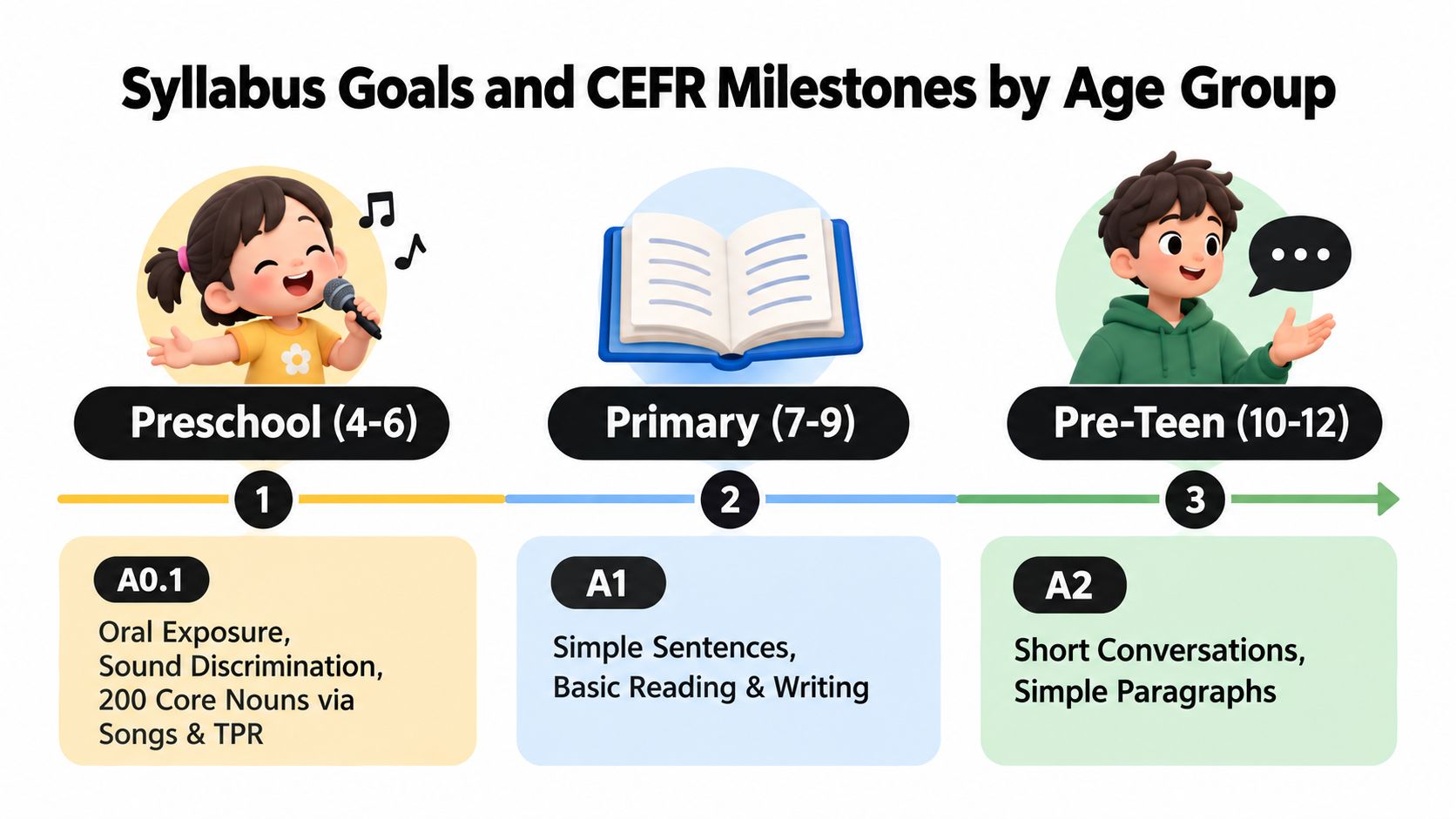
For a parent-friendly explanation of level names, this overview of German CEFR levels for Hong Kong learners is useful, but the simpler point is this: age changes what “progress” should look like.
Preschool ages
At preschool stage, the goal is oral exposure, sound discrimination and classroom response. You want songs, action-based language, familiar objects, greetings and confidence.
I would not push formal literacy here. It's unnecessary and often clumsy.
Lower and upper primary
In lower primary, children should move into basic reading, short speaking turns, common verbs and controlled sentence-building. In upper primary, that should become more organised, with short written output and more stable comprehension.
A realistic age-by-age map
The official exam reality for DSE
For HKDSE German, the pathway is not vague. Students taking German as a Category C subject must sit the Goethe-Zertifikat at A2 level or above within the two years before the HKDSE they take. For example, 2025 candidates needed an exam taken in 2023 and/or 2024 according to the Goethe-Institut Hong Kong DSE exam information.
That single fact should shape planning for teens. If your child may use German for DSE, don't drift through random beginner classes.
If a school promises dramatic CEFR jumps in one short term, ask exactly how they assess speaking, listening, reading and writing. Serious programmes can explain the path clearly.
When to Enrol, Trial Classes and Placement Tests
Timing matters in Hong Kong because family calendars fill up early. If you wait until term starts, your choices shrink and your child is more likely to land in the wrong group.
When parents should move
I advise parents to enquire a few weeks before a new term or holiday block, not after schedules are finalised. The point isn't urgency for its own sake. The point is to secure a group that fits age, level and travel pattern.
What a trial class should reveal
A proper trial class should answer three questions fast:
A trial isn't just a taster. It's a stress test for fit.
Placement matters more than most parents think
Even complete beginners should be screened properly if they've had any exposure at school, at home or with a helper. Mixed-ability groups slow stronger children and frustrate true beginners.
Look for placement methods that include:
Keep one long-term policy point in mind
If you're thinking ahead to adulthood, Hong Kong's Continuing Education Fund has a defined age rule. Residents aged 18 to 65 have been eligible to apply for reimbursement of 80% of the fee of a registered course, up to HK$10,000 per applicant, while older legislative records also noted a narrower 18 to 60 rule in the Legislative Council paper on CEF policy mechanics.
That doesn't help a child now. It does matter for long-term planning once a learner turns 18 and begins paying under their own HKID.
Why Native-Led Small-Group German Tuition Works
Children copy what they hear. That's why teacher quality matters so much in beginner German.
Native input changes early habits
At A1 and A2 stage, pronunciation habits set hard. A native-speaking teacher models real vowel length, rhythm, sentence stress and natural classroom phrases from the start.
That's difficult to replicate in a generic tutorial room where German is treated like just another add-on subject. If you're comparing teaching styles, this page on native German-speaking tutors in Hong Kong gives a useful benchmark for what to look for.
Small groups are usually the sweet spot
Children need repetition, but they also need turns. In a small group, they hear peers, build confidence and speak often enough to improve.
One-to-one can help in catch-up situations, but many children stay more motivated with peers. Massive groups are the weak middle. Too little speaking time. Too much passivity.
Structured curriculum beats random enrichment
I'm quite firm. German should not restart every term with colours, animals and greetings.
A serious centre should be able to tell you:
One factual example in Hong Kong is German Cultural Association Hong Kong(GCA), which offers in-person classes near Tsim Sha Tsui and Causeway Bay MTR as well as online sessions, teaches in small groups with a maximum of 6 students, and focuses on native-speaking instruction plus exam preparation such as Goethe-Zertifikat, IGCSE, A-level and IB, according to the publisher information provided for this article.
A good German programme in HK should be able to describe outcomes by level, not just by age.
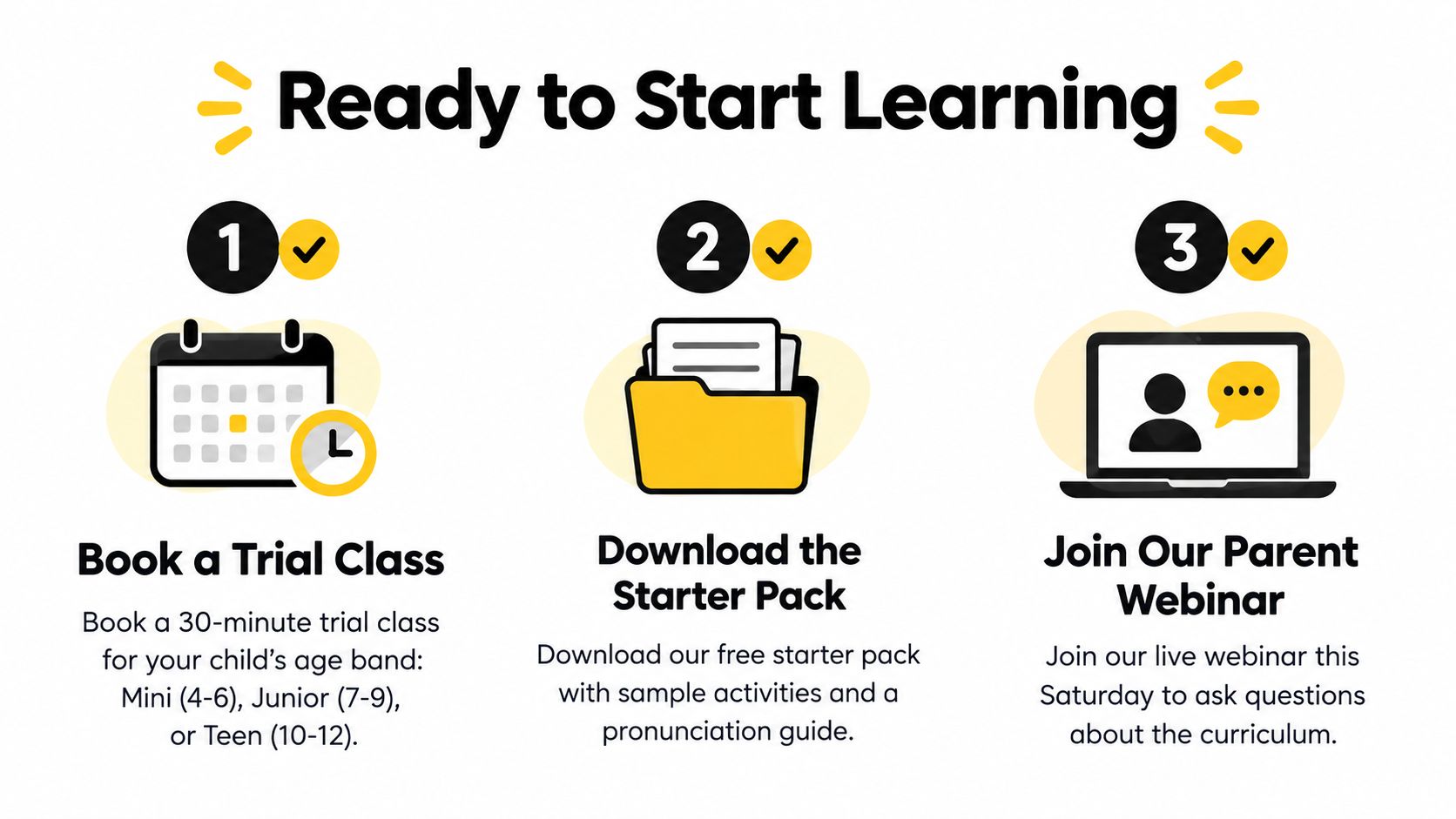
Ready to Start Learning
If you're still hesitating, don't spend another term comparing websites. Make three decisions this week.
Step one is a proper trial
Book a trial class in the right age band. Don't just choose the nearest centre or the only free slot.
Your child should leave the lesson looking one of two ways. Calm and interested, or energised and engaged. If they leave glazed over, the level or format is wrong.
Step two is accurate placement
Request a placement check before committing to a full term, especially if your child has picked up German through school, travel, relatives or previous classes.
That avoids the classic HK mistake of putting a child into the lowest open group instead of the correct one.
Step three is scheduling around real life
German needs consistency more than intensity. A workable weekly slot beats an ambitious plan that collapses after two weeks because of homework, music and transport.
My final recommendation by age
A niche point matters here too. In Hong Kong, childhood language enrolment is dominated by English and Putonghua, and only 2% chose other languages in one local enrichment study reported in the Education University of Hong Kong material. That means German is usually a deliberate family choice, not a default one. So treat it as a pathway decision with an outcome attached.
If you want a structured route instead of guesswork, German Cultural Association Hong Kong(GCA) offers native-led German classes for preschoolers, children, teens and adults in both in-person and online formats. If your family is deciding when to start, which age band fits, or how to plan toward Goethe-Zertifikat or DSE-related goals, visit the site and book a trial or placement consultation.
German Classes for Kids Hong Kong: Ages

Joining a German Course Mid-Term: September Intake Guide for Hong Kong 2026/27


